
Table of Contents
- What Independent Peptide Testing Actually Verifies
- How to Read a Peptide Certificate of Analysis
- HPLC vs Mass Spectrometry for Peptides
- What ISO/IEC 17025 Certified Peptide Testing Means for Your Lab
- Batch-to-Batch Variability: The Hidden Threat to Reproducibility
- The Cost-Benefit Case for Independent Testing
- Legal and Ethical Boundaries of Research Peptide Use
- Frequently Asked Questions
Last Updated: September 14, 2026
What Independent Peptide Testing Actually Verifies
Independent peptide testing means having a batch of synthesized peptides analyzed by a laboratory with no financial relationship to the manufacturer or supplier. At Minuteman Peptides, this is a baseline requirement, not a premium add-on: the integrity of independent peptide testing determines whether your experimental results mean anything at all.
The distinction comes down to two separate questions a single purity figure cannot answer.
Purity vs. Identity: Two Separate Questions
Purity measures how much of your sample is the target compound. A 98% purity result means 2% of the mass is something you did not order (pubmed.ncbi.nlm.nih.gov).
Identity confirms that the dominant compound is actually the peptide you specified, with the correct amino acid sequence and molecular weight. These are independent properties. A sample can be 99% pure and 100% the wrong peptide.
That scenario is not hypothetical. Sequence errors during synthesis produce a compound that is chemically clean, stable, and useless for your research question. If your assay depends on a specific receptor interaction, the wrong sequence will not bind, and you will spend weeks chasing a result that was never achievable.
Why Supplier-Issued Data Falls Short
Supplier-generated data is not automatically dishonest, but it carries a structural conflict of interest: the party selling you the material also controls the testing, the reporting, and what gets published. Many suppliers test a single reference batch and attach that report to every subsequent shipment.
A common mistake is accepting a COA without checking whether the batch number on the document matches the one on your vial. This mismatch is one of the most frequent problems researchers encounter, and it is almost impossible to detect unless you request batch-specific documentation in writing.
How to Read a Peptide Certificate of Analysis
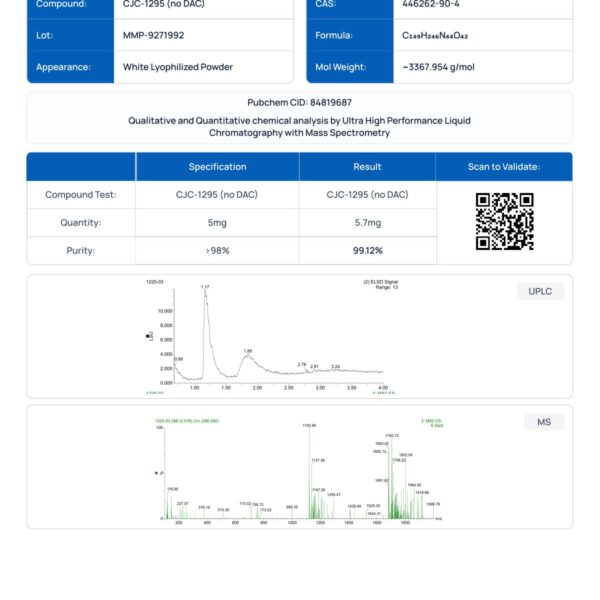
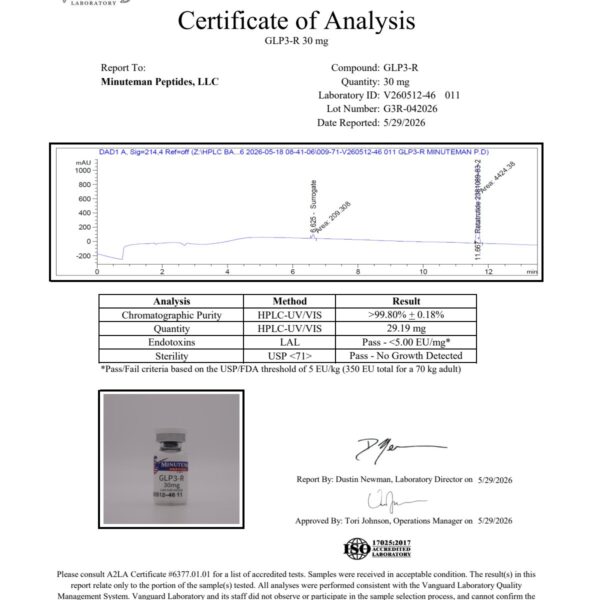
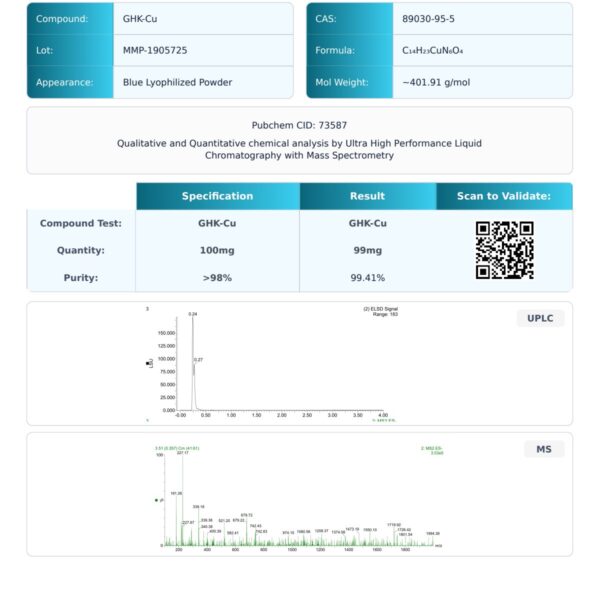
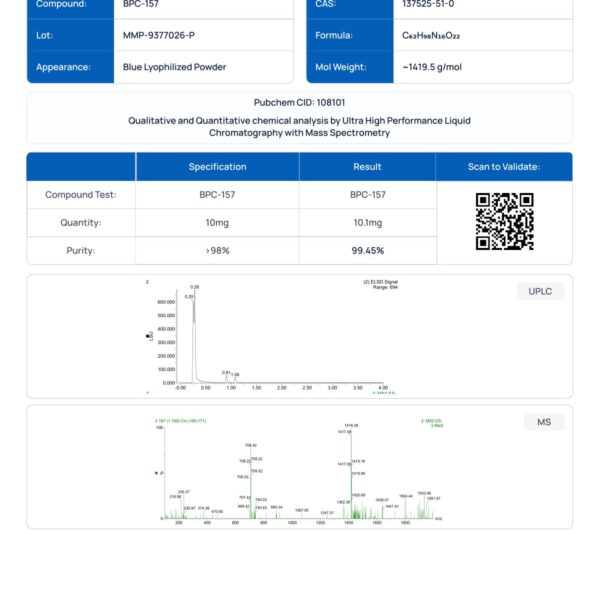
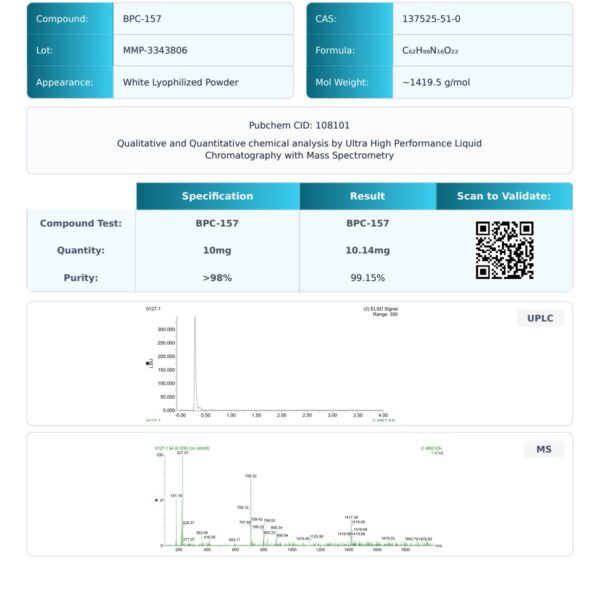
A Certificate of Analysis (COA) is a formal document issued by a testing laboratory reporting the measured properties of a specific batch, including identity, purity, and analytical method. The skill that protects your research is reading the data behind those fields and recognizing patterns that indicate a report was assembled for marketing rather than measurement.
The Five Fields That Matter Most
- Batch or lot number, must match your vial exactly, not a generic product code
- Analytical method, HPLC, mass spectrometry, or both; a COA citing neither is worthless
- Purity percentage with method, the figure is meaningless without knowing how it was measured
- Molecular weight, observed vs. theoretical, confirms compound identity
- Testing laboratory name and accreditation, an anonymous lab cannot be verified
What most guides miss is the fourth field. A COA that reports purity but omits observed molecular weight has not confirmed identity at all. Request the mass spectrometry data separately if it is not included.
Reading the Chromatogram, Not Just the Number
The purity percentage is a summary of a chromatogram, and the chromatogram is where the real information lives. A reversed-phase HPLC trace plots absorbance (typically 214 nm for the peptide backbone) against retention time. Look for:
- A single dominant peak with a clean baseline on either side. A main peak sitting on a rising slope or a shoulder is a co-eluting impurity, even if the software integrates it as one number.
- Peak symmetry. A tailing factor above roughly 2.0 signals column degradation, secondary interactions, or an unresolved impurity under the main peak.
- Impurity peaks you can see. Small peaks eluting before the main peak (more hydrophilic) or after it (more hydrophobic) are the deletion sequences and truncated fragments synthesis produces.
- The integration baseline. Software will integrate a peak against a baseline that cuts off a shoulder. If the reported purity seems high but the trace looks crowded, trust the trace.
Red Flags in a COA
- No chromatogram image, only a table. A purity number with no trace behind it cannot be audited.
- Identical purity values across unrelated batches. Real synthesis produces variation. A supplier whose every batch reads exactly 99.1% is either not testing each batch or rounding to a marketing number.
- Method description too vague to reproduce. “HPLC” alone is not a method. You want column chemistry, mobile phase, gradient, flow rate, and detection wavelength.
- A testing lab with no verifiable accreditation scope. Accreditation is granted per method and per facility, so a lab accredited for something unrelated to peptide characterization is not qualified here.
- A COA dated before the batch was manufactured. This happens when suppliers recycle an old report.
- No observed molecular weight, or a value that does not match theoretical within instrument tolerance. Expect agreement within a fraction of a Dalton on a modern mass spectrometer.
If a COA lists only a purity percentage with no chromatography trace, no method details, and no lab identity, treat it as marketing material rather than analytical documentation. Researchers who accept these documents at face value often discover the problem only after an experiment fails to replicate.
A Five-Minute Review Routine
Confirm the batch number matches your vial, then check the method block for both HPLC and MS. Read the chromatogram before the purity number, and verify observed mass matches theoretical. Finally, confirm the testing laboratory’s name and accreditation scope independently. If any step fails, the document is not usable as analytical evidence, however polished it looks.
HPLC vs Mass Spectrometry for Peptides
HPLC and mass spectrometry answer different questions, and reputable testing uses both. High-performance liquid chromatography (HPLC) separates the components of a sample and quantifies how much of each is present, producing the purity figure. Mass spectrometry (MS) measures the mass-to-charge ratio of the molecules present, confirming that the dominant compound has the expected molecular weight.
| Method | What It Measures | Primary Use | Limitation |
|---|---|---|---|
| HPLC | Relative abundance of components | Purity percentage, impurity profile | Cannot confirm identity |
| Mass Spectrometry | Molecular mass of compounds | Compound identification, sequence confirmation | Cannot quantify purity alone |
| HPLC + MS combined | Both purity and identity | Full analytical verification | Higher cost per sample |
How HPLC Actually Produces a Purity Number
Reversed-phase HPLC is the workhorse method for peptide purity. The sample is injected onto a hydrophobic stationary phase (commonly C18 silica), and a gradient of increasing organic solvent, typically acetonitrile in water with trifluoroacetic acid, pushes components through at rates determined by their hydrophobicity. Detection is usually by UV absorbance at 214 nm.
The purity percentage is not a direct measurement: it is the main peak area divided by the total area of all integrated peaks, times 100. That means the number is only as honest as the integration. A shoulder merged into the main peak inflates purity, and an impurity below the integration threshold disappears entirely. Two labs can therefore report different purity figures for the same vial.
How Mass Spectrometry Confirms Identity
Electrospray ionization (ESI) is the standard interface for peptide MS. The sample is ionized into multiply charged species, and the instrument reports mass-to-charge (m/z) ratios. Because peptides carry multiple charges, one compound appears as a series of peaks spaced by charge state, which software deconvolutes into a single molecular weight.
That deconvoluted mass is what you compare against the theoretical mass calculated from the intended amino acid sequence. Agreement within a fraction of a Dalton confirms the sequence is what it claims to be. A mass off by one amino acid residue, roughly 57 Da for a glycine substitution, is a sequence error, not a purity problem, and no amount of HPLC will catch it.
Tandem MS and Sequence-Level Confirmation
Where exact sequence matters, receptor binding studies, structure-activity work, anything where a single residue substitution changes the result, single-stage MS confirms mass but not sequence order, since sequence isomers have identical masses. Tandem mass spectrometry (MS/MS) fragments the peptide along the backbone and reads the fragment ladder, confirming sequence. Not every routine COA includes MS/MS, so if your work depends on sequence fidelity, ask whether it was performed.
Where Each Method Fails
- HPLC alone cannot distinguish your peptide from a sequence isomer, a closely related impurity with similar hydrophobicity, or a compound that co-elutes under the chosen gradient.
- MS alone cannot tell you how much of the sample is your target compound versus a co-purifying contaminant of a different mass that happens to ionize.
- Neither method detects residual solvents, heavy metal catalysts, or endotoxin. Those require separate assays, requested explicitly.
A purity result from HPLC without a corresponding mass spectrum tells you the sample is clean but not what it is. A mass spectrum without HPLC tells you the right molecule is present but not how much of the sample it represents.
What ISO/IEC 17025 Certified Peptide Testing Means for Your Lab
ISO/IEC 17025 certification indicates that a testing laboratory has been assessed against internationally recognized criteria for technical competence, and that its methods, equipment, and personnel meet documented standards. The ISO/IEC 17025 standard overview sets out the general requirements for testing and calibration laboratories.
For your research, the certification provides three practical protections: methods are validated rather than improvised, results are traceable to documented procedures, and an external audit process creates accountability an unaccredited lab does not carry.
The question worth asking any supplier is not whether they claim accreditation, but which specific laboratory performed the test and under what accreditation scope. Accreditation is granted per method and per facility, not as a blanket credential. A lab accredited for water analysis is not thereby qualified to characterize synthetic peptides.
Batch-to-Batch Variability: The Hidden Threat to Reproducibility
Batch-to-batch variability is the single most underappreciated threat to research reproducibility in peptide work. Synthesis conditions shift. Reagent lots change. Purification columns degrade. Two batches of the same peptide from the same supplier, ordered six months apart, can differ measurably in purity and impurity profile.
This is why testing a single reference batch proves very little. If you are running an 18-month study, the relevant question is whether every batch you receive has been independently verified, not whether the supplier’s flagship sample once tested well.
Request the COA for the specific batch number printed on your vial before you run your first assay. If the supplier cannot produce batch-specific documentation, that tells you more about their process than any purity claim on their website.
Reproducibility depends on standardizing every variable you control. Compound purity and identity are among the few you can pin down, which makes independent verification one of the highest-use steps available.
The Cost-Benefit Case for Independent Testing
Independent testing adds cost and lead time to every order. The relevant comparison is not testing cost versus no testing cost, but testing cost versus the cost of an experiment that has to be repeated because the input material was not what it claimed to be.
Consider what a failed run consumes. Reagent costs are the smallest part; the larger losses are instrument time, personnel hours, and delay to your funding or publication timeline. When a result fails to replicate, you face an uncomfortable question: was the finding wrong, or the material? Without independent verification you cannot answer it.
A practical approach is to treat verification as a fixed line item in your materials budget rather than a discretionary expense, and to concentrate testing on the batches that feed your most consequential experiments.
Legal and Ethical Boundaries of Research Peptide Use
Research peptides occupy a narrow and carefully bounded space. The FDA guidance on compounded and research-use materials makes clear that materials labeled for research use are not approved for human or animal consumption, and that distinction is not a formality.
For principal investigators, several obligations follow. Documentation must be retained so the provenance of every compound in published work can be demonstrated, and institutional review and biosafety protocols must be followed where applicable. Labeling and storage requirements set by your institution and by federal and state rules must be met. Because some peptides are regulated under federal scheduling or import statutes, confirm a compound’s legal status with your institutional compliance office rather than relying on supplier assurances.
Ethically, the standard is straightforward: publishing results from unverified material burdens every researcher who builds on that work. Independent peptide testing is a contribution to the literature as much as a quality control step.
Reproducibility is not a luxury in metabolic pathway and signaling research; it is the foundation everything else rests on. Minuteman Peptides sources material from cGMP-certified, US-based manufacturing facilities and subjects every batch to independent ISO/IEC 17025 certified third-party testing, with HPLC and mass spectrometry results published in transparent Certificates of Analysis. Free shipping applies on orders over $200, and secure payment options are available. Get started with Minuteman Peptides and build your next study on verified compounds.
Frequently Asked Questions
What is the most accurate lab test for verifying peptide purity?
No single test covers everything. HPLC separates and quantifies impurities, giving you a purity percentage. Mass spectrometry confirms the molecular weight matches the expected amino acid sequence, catching misidentified or truncated peptides. Together they answer two different questions: how much is there, and is it the right thing. Independent labs running both methods on the same sample provide the strongest verification, which is why ISO/IEC 17025 certified peptide testing combines them.
How do I know an ISO/IEC 17025 certification is legitimate?
Ask for the testing lab’s scope of accreditation and verify it directly with the accrediting body. ISO/IEC 17025 is a standard for testing and calibration laboratories, not a marketing label. Legitimate labs can show you their certificate, the specific tests they are accredited for, and the accreditation body that assessed them. If a supplier only shows a logo without documentation, treat the claim as unverified and request the actual certificate.
What should researchers look for in a Certificate of Analysis?
Check five things: the lot or batch number matching your vial, the analytical method used (HPLC, mass spec, or both), the purity result with the chromatogram attached, the molecular weight confirmation, and the date of testing. A COA without a chromatogram is just a number. Reputable suppliers include the actual instrument output so you can see peak shape, retention time, and any minor impurity peaks rather than trusting a summary.
Why is independent third-party testing essential for research compounds?
Suppliers test their own products, which creates a conflict of interest. Independent peptide testing uses a lab with no financial stake in the result, so a failing batch stays a failing batch. This matters most for reproducibility: if your results depend on a compound that is 82% pure instead of 98%, your data reflects the impurity, not the peptide. Third-party verification gives you a documented fact you can cite in methods sections and defend in peer review.