Table of Contents
- Why Peptide Quality Issues Compromise Research Results
- Synthetic Peptide Impurities: What Can Go Wrong
- HPLC Analysis for Peptides: The First Line of Defense
- How to Read COA Documents Like a Critical Reviewer
- GMP vs. RUO Peptides: Standards and What They Mean
- Troubleshooting Failed Experiments Linked to Peptide Quality
- Building a Documentation Checklist for Peptide Verification
- Conclusion: Protecting Your Research Investment
- Frequently Asked Questions
Last Updated: September 9, 2026
Why Peptide Quality Issues Compromise Research Results
A failed experiment costs weeks of work, thousands in reagents, and often leads researchers to question their own methodology. Peptide quality issues in biotechnology research are frequently the true culprit, silently undermining assays before data collection even begins.
Synthetic peptides are complex molecules whose quality depends on synthesis accuracy, purification depth, and handling protocols. When a supplier cuts corners, the researcher inherits the problem. The gap between claimed purity and actual composition is often wider than buyers expect. This guide explains how to close that gap and protect your experimental integrity.
Peptide quality is the single most controllable variable in many in vitro studies. Understanding what can go wrong, how to detect it, and what documentation proves it is essential for any laboratory serious about reproducibility.
Synthetic Peptide Impurities: What Can Go Wrong
Synthetic peptide impurities fall into several categories, each with distinct causes and consequences for downstream applications. Truncated sequences occur when the synthesis chain terminates early, producing shorter peptides that may act as competitive inhibitors or generate false signals in binding assays. Deletion peptides arise from skipped coupling steps during solid-phase synthesis, creating sequences missing internal amino acids.
Oxidation and aggregation present additional risks. Methionine and cysteine residues are particularly vulnerable to oxidation during storage or handling, altering the peptide’s structure and activity (PubMed). Aggregation, driven by hydrophobic regions or high concentration, can reduce solubility and bioavailability in assay buffers.
Counter-ion content deserves special attention. Most peptides are purified via HPLC using trifluoroacetic acid (TFA) in the mobile phase, leaving TFA salts that can interfere with cell-based assays. The presence of residual solvents, scavengers from cleavage steps, or acetate from alternative purification methods all contribute to a contaminant profile that varies by supplier.
The cumulative effect of these impurities is batch-to-batch inconsistency. One vial may perform acceptably while the next fails, not because your protocol changed, but because the peptide composition did.
HPLC Analysis for Peptides: The First Line of Defense
High-performance liquid chromatography (HPLC) is the workhorse analytical method for assessing peptide purity, but treating it as a black box that outputs a single purity number is a common and costly mistake. HPLC analysis for peptides separates components based on their differential interaction with a reversed-phase (RP) stationary phase, typically a C18 or C4 silica column, using a gradient of water and an organic modifier such as acetonitrile, both acidified with 0.1% TFA. The choice of column and gradient is not arbitrary; a highly hydrophobic peptide may require a C4 column and a steep gradient, while a short, hydrophilic sequence may need a C18 column with a shallow gradient.
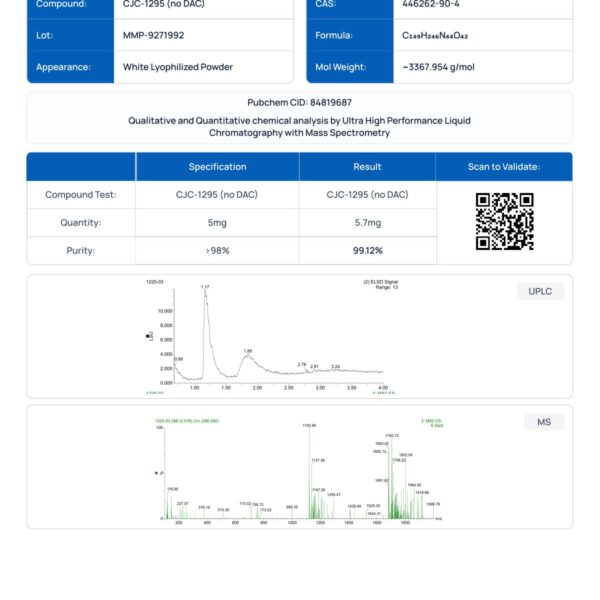
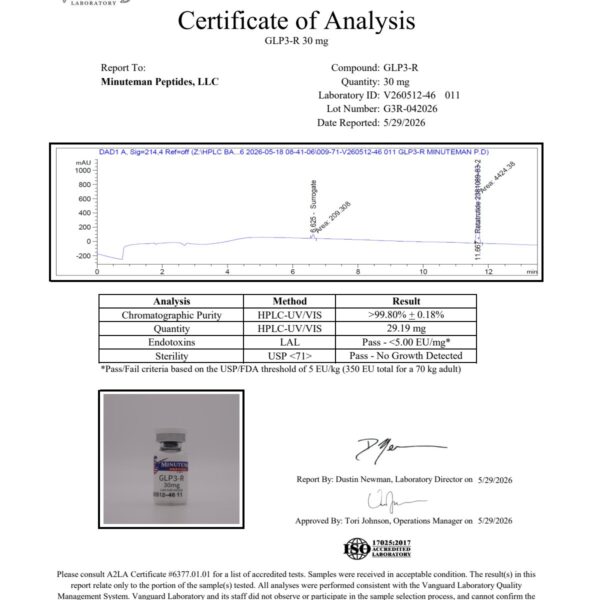
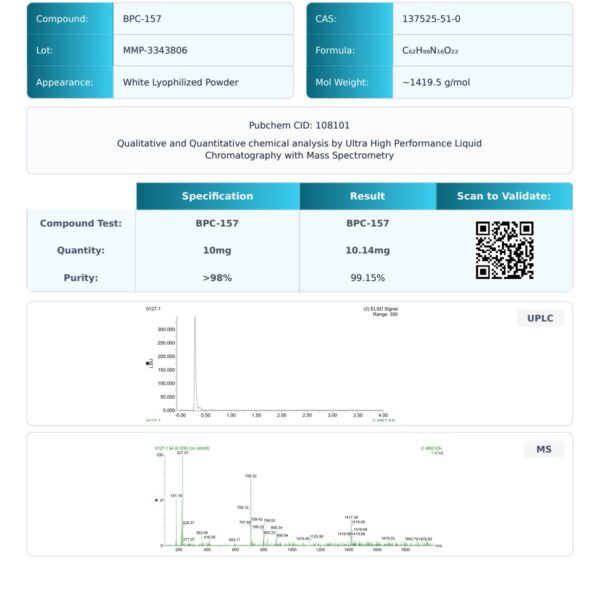
The chromatogram itself offers diagnostic information far beyond the area-percent purity figure on a Certificate of Analysis. A purity percentage above 95% is commonly cited as acceptable for research use, but that number alone tells an incomplete story (peer-reviewed research). A sharp, symmetrical main peak suggests a homogeneous product; a leading or trailing shoulder is a red flag for co-eluting species, often deletion peptides or diastereomers.
Method parameters matter immensely. A COA that reports “HPLC purity: 98%” without listing the column type, gradient slope, detection wavelength (typically 214 nm for peptide bonds, not 280 nm), and flow rate provides insufficient information to judge whether the method could resolve your peptide’s impurity profile.
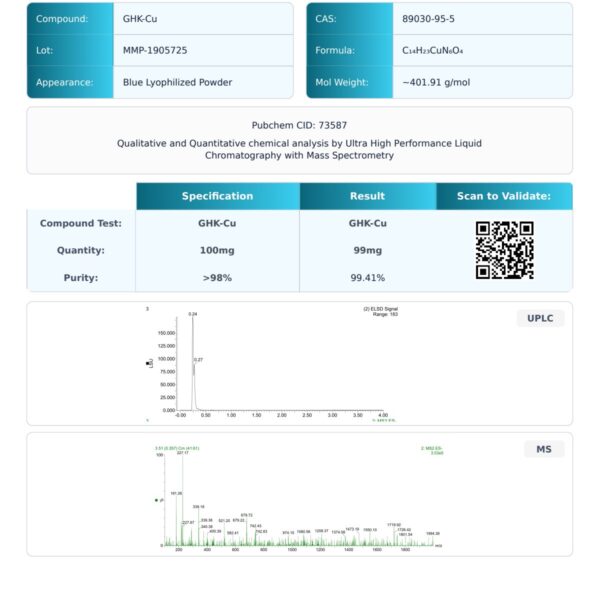
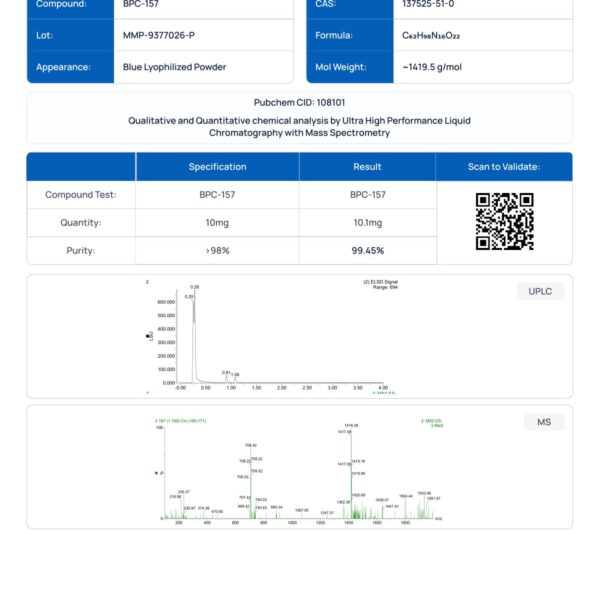
Mass spectrometry (MS) is the essential complement to HPLC, providing the molecular weight confirmation that chromatography cannot. This verification step catches the most dangerous failure mode: a peptide with the correct retention time but wrong sequence. Electrospray ionization (ESI-MS) is the most common technique; the observed mass should match the theoretical average mass within 0.5 Da for a peptide under 3 kDa. A mass discrepancy of 16 Da indicates an oxidation event, while a difference of 98 Da suggests residual TFA adducts. Together, HPLC and MS provide confidence that the molecule you ordered is the molecule you received.
For quantitative assays, consider requesting the actual chromatogram and MS trace, not just the summary numbers. Reviewing the raw data allows you to assess peak shape and baseline resolution yourself, rather than trusting a single area-percent calculation.
How to Read COA Documents Like a Critical Reviewer
A Certificate of Analysis (COA) is your primary evidence of peptide quality, yet most researchers glance at the purity percentage and file the document away. Learning how to read COA documents critically transforms this paperwork into a practical quality assurance tool.
Start with the basics: confirm the product name, sequence, and batch number match your order exactly. A mismatch here invalidates everything downstream. Verify the reported molecular weight matches the theoretical value for your sequence.
Examine the analytical methods listed. A credible COA reports both HPLC purity and mass spectrometry confirmation. If only HPLC appears, sequence verification is missing. If the COA lacks method parameters such as column type, gradient conditions, or detection wavelength, the analysis may not have been suitable for your peptide.
Check the date of analysis. Peptide stability diminishes over time, even when lyophilized and stored properly. A COA from eighteen months ago describes a product that may have degraded significantly since testing.
Key COA Sections Beyond the Purity Percentage
Beyond the headline purity number, several COA sections deserve scrutiny. The appearance description, such as “white lyophilized powder,” should match what you received. Discoloration suggests degradation or contamination.
Solubility information is often overlooked but practically critical. If the COA indicates the peptide dissolves readily in water but your buffer requires organic solvent, you face unnecessary troubleshooting.
Storage conditions specified on the COA guide your handling protocols. Peptides stored at room temperature during transit may arrive compromised, regardless of the original quality.
Counter-ion and water content measurements reveal how much of the vial’s weight is actually peptide. A product reported as 80% peptide, 10% water, and 10% counter-ion requires careful calculation for accurate molar concentrations.
GMP vs. RUO Peptides: Standards and What They Mean
The distinction between GMP (Good Manufacturing Practice) and RUO (Research Use Only) peptides is frequently misunderstood, leading to either unnecessary expense or inadequate quality for the application. For a laboratory using peptides solely in in vitro assays or animal models, the legal and safety framework is governed by different rules than those applying to clinical-grade materials.
RUO peptides are manufactured for research applications and are not intended for human or animal administration. They are exempt from current Good Manufacturing Practice (cGMP) regulations as defined in 21 CFR Parts 210 and 211, though they must still be manufactured in facilities that meet basic safety and labeling standards. There is no FDA oversight of the synthesis process, purification methods, or analytical testing. The quality of RUO peptides varies significantly between suppliers.
GMP peptides, by contrast, are produced under strictly controlled conditions that comply with FDA regulations for pharmaceutical manufacturing, involving documented processes, validated equipment, environmental monitoring, comprehensive quality systems, and full traceability. Every step, from resin loading to final lyophilization, must follow written, approved protocols, with deviations documented and investigated. Release testing must be performed by a quality control unit independent from production. GMP peptides typically command a 3- to 10-fold price premium over equivalent RUO products.
For most in vitro research, high-quality RUO peptides with verified analytical data are entirely appropriate. The critical factor is not the GMP label but the rigor of the analytical testing and the transparency of the documentation. A well-characterized RUO peptide with independent third-party validation can outperform a poorly documented GMP product. Some suppliers label products as “GMP-grade” without true cGMP manufacturing; verify claims by asking for the facility’s FDA registration number and the batch’s manufacturing date relative to the COA.
For non-clinical research, the regulatory landscape focuses on data integrity and reproducibility rather than manufacturing certification. The FDA’s GLP guidance (21 CFR Part 58) applies to studies supporting investigational new drug applications, but most academic and early-stage biotechnology research falls outside this scope. What matters for the peer-reviewed literature and funding agencies is that you can document reagent quality; journals increasingly require detailed reagent information, and a COA showing verified purity and identity is the minimum evidence needed to support claims of reproducibility.
If your work may eventually support a regulatory submission, even years later, peptide quality documentation becomes part of the audit trail. Switching from an RUO to a GMP peptide late in development can require bridging studies to demonstrate comparability. Selecting a supplier who can provide both RUO and GMP versions of the same sequence with comparable analytical profiles can save substantial time and cost downstream.
Troubleshooting Failed Experiments Linked to Peptide Quality
When an experiment fails, peptide quality should be among the first suspects, not the last resort. A systematic troubleshooting approach saves time and prevents false conclusions about your biological system.
Step one: confirm peptide identity. Re-run mass spectrometry on your stock solution. If the molecular weight does not match expectations, the peptide is wrong or degraded, and no amount of protocol optimization will fix it.
Step two: assess solubility in your actual buffer. A peptide that dissolves in water may precipitate in PBS or cell culture media. Visual inspection for cloudiness or particulates before use catches this issue early.
Step three: evaluate stability under your experimental conditions. Peptides containing oxidation-prone residues may degrade during prolonged incubations. Enzymatic degradation by proteases present in serum or cell lysates can also eliminate activity. Running a time-course control distinguishes degradation from lack of intrinsic activity.
Step four: compare batch behavior. If a new batch fails where a previous batch succeeded, request the COA for both and compare impurity profiles. Differences in counter-ion content or trace impurities can dramatically alter cell-based assay results.
A common mistake is assuming the peptide is pure because the supplier states 98% purity. Without independent verification of that claim, you are trusting an unverified number. If your experiments are sensitive to minor impurities, consider third-party validation of critical batches before launching large studies.
Building a Documentation Checklist for Peptide Verification
Standardizing how your laboratory verifies incoming peptides prevents quality issues from reaching the bench. A documentation checklist ensures every batch meets the same criteria before experimental use.
| Verification Step | What to Check | Documentation Required |
|---|---|---|
| Identity confirmation | Sequence and molecular weight match order | Mass spectrometry report |
| Purity assessment | HPLC purity percentage and chromatogram | HPLC trace with method parameters |
| Quantity verification | Peptide weight and water/counter-ion content | COA with net peptide weight |
| Solubility testing | Dissolves in target buffer at required concentration | Solubility test record |
| Storage verification | Arrival conditions and temperature logs | Shipping and receiving records |
| Batch comparison | Impurity profile matches previous acceptable batches | Side-by-side COA comparison |
Store all documentation in a centralized system accessible to every researcher using the peptide. When a batch fails, the documentation enables rapid identification of whether the issue lies in synthesis, handling, or experimental design.
For critical long-term studies requiring batch-to-batch consistency across months, establish a relationship with suppliers who provide complete analytical data on every batch. Ask about their manufacturing standards, testing protocols, and how they handle batch variations. According to National Institutes of Health guidance on research reproducibility, rigorous documentation of reagent quality is fundamental to reproducible research practices.
A standardized verification checklist transforms peptide quality from an assumption into a measured variable. Every batch that passes your criteria enters the lab with documented evidence of its suitability for your specific application.
Conclusion: Protecting Your Research Investment
Peptide quality issues in biotechnology research represent a preventable source of experimental failure, wasted resources, and unreliable data. The cost of rigorous verification is trivial compared to the cost of repeating months of experiments built on compromised reagents.
The tools for protection are available to every laboratory: HPLC analysis for peptides confirms purity, mass spectrometry verifies identity, and critical COA review reveals the limitations behind a single percentage. Understanding synthetic peptide impurities enables informed decisions about which products meet your experimental standards.
Suppliers who prioritize transparency make this process straightforward. Minuteman Peptides sources materials from cGMP-certified, US-based manufacturing facilities and subjects every batch to independent ISO/IEC 17025 certified third-party testing. Our verified HPLC and Mass Spectrometry results, published in transparent Certificates of Analysis, give researchers the documented evidence needed for confident experimental design.
Browse our catalog and secure peptides with verified quality for your next study.
Frequently Asked Questions
What are the most common impurities found in synthetic peptides?
The most common impurities are truncated sequences and deletion peptides resulting from incomplete coupling reactions during synthesis. Other frequent contaminants include oxidation products, residual solvents, and high counter-ion content like trifluoroacetic acid (TFA) from the cleavage step. These impurities can trigger immunogenic responses or interfere with your assay even at low levels. A detailed COA from a supplier using HPLC and Mass Spectrometry testing will list these impurities, enabling you to assess the true contaminant profile beyond the simple purity percentage.
How can researchers verify the purity of research-grade peptides?
The most reliable method is to review the Certificate of Analysis (COA) and confirm it includes data from HPLC analysis for peptides and Mass Spectrometry. HPLC provides the purity percentage, while Mass Spectrometry confirms the molecular weight and sequence identity. For high-stakes studies, consider requesting the raw chromatogram and seeking third-party validation from an ISO/IEC 17025 certified laboratory. This independent testing verifies batch-to-batch consistency and guards against mislabeling risks from suppliers who may only test a single batch.
Why is third-party ISO/IEC 17025 testing critical for peptide research?
Third-party testing provides an unbiased check on the manufacturer’s claims. When a supplier tests its own products, there is a potential conflict of interest that can lead to inflated purity numbers. An ISO/IEC 17025 certified laboratory operates under strict quality assurance standards, ensuring that the analytical testing methods are validated and the results are accurate and traceable. This independent verification is essential for confirming that the peptide quality meets your specifications and that the data you rely on for publication is defensible.
What are the risks of using low-quality peptides in biotechnology studies?
Low-quality peptides can derail your research in several ways. Impurities like truncated sequences can act as competitive inhibitors or create false positive signals, leading to invalid conclusions. Inconsistent peptide stability and batch-to-batch variation compromise experimental repeatability, making it difficult to replicate results. These issues waste time and resources and can damage your lab’s reputation if flawed data is published. Verifying purity and documentation before use is a critical step in protecting your research outcomes.