Table of Contents
- What cGMP Manufacturing Standards Mean for Research Compounds
- GMP Grade vs Reagent Grade: Which One Protects Your Data?
- The FDA’s Role in cGMP Manufacturing Standards
- Core Components of cGMP Compliance
- Why ISO/IEC 17025 Third-Party Testing Matters
- Verifying Quality with HPLC and Mass Spectrometry Analysis
- Transitioning from Research Use Only to cGMP-Grade Materials
- Conclusion: Building a Reproducible Research Foundation
- Frequently Asked Questions
Last Updated: September 5, 2026
What cGMP Manufacturing Standards Mean for Research Compounds
cGMP manufacturing standards are the FDA’s regulatory framework for consistent production and quality control. For research compounds, these standards determine whether your data reflects true biological activity or the consequences of contamination and batch inconsistency.
The rigor of your manufacturing process sets the ceiling for the reliability of your results. When you purchase peptides for in vitro studies, you are buying the assurance that every vial matches the certificate of analysis and that the next batch will behave identically.
GMP Grade vs Reagent Grade: Which One Protects Your Data?
Reagent grade compounds meet general chemical purity specifications but may contain impurities that confound sensitive biological assays. GMP grade materials are produced under documented process controls, validated equipment, and full traceability from raw material procurement to final release.
For metabolic pathway or growth signaling research, trace impurities that would never matter for a buffer solution can activate or inhibit cellular receptors and produce artifacts. A common mistake is assuming high purity alone guarantees suitability for biological research. Purity tells you what is present; GMP standards tell you how consistently it was made and what else might be in the vial.
| Grade | Manufacturing Controls | Documentation | Best For |
|---|---|---|---|
| Reagent Grade | Basic chemical purity | Limited COA | Buffer prep, general lab use |
| GMP Grade | Full process validation, environmental monitoring | Complete batch records, traceability | Sensitive in vitro biological assays |
The FDA’s Role in cGMP Manufacturing Standards
The FDA enforces cGMP standards under 21 CFR Parts 210 and 211, establishing minimum requirements for methods, facilities, and controls in drug manufacturing. While research-use-only compounds fall outside FDA drug approval, manufacturing facilities can still elect to operate under cGMP to ensure product integrity.
Many researchers mistakenly believe that “for research use only” labeling exempts them from quality concerns. The FDA’s cGMP framework exists to protect product integrity through systematic quality management regardless of end use.
The practical implication for your lab is this: cGMP manufacturing standards reduce the risk profile of your research by ensuring that the only variable changing between experiments is the one you intend to study. According to FDA guidance on current good manufacturing practice, these regulations are designed to assure that products consistently meet quality standards appropriate for their intended use.
What the FDA Actually Inspects, and What That Means for Your Supplier Choice
The FDA conducts pre-approval inspections (PAIs) for new drug applications and routine surveillance inspections, typically every two years for domestic facilities. Suppliers who also manufacture clinical-grade material are subject to routine surveillance, and those inspection records are public under the Freedom of Information Act.
To vet a supplier, ask whether their facility has undergone a recent FDA inspection and request the Establishment Inspection Report (EIR) or Form 483 observations. A Form 483 lists objectionable conditions; receiving one is common and not automatically disqualifying. Repeated observations about inadequate deviation handling or missing batch records are red flags, while minor documentation gaps are less concerning for research-use material.
The FDA distinguishes between “cGMP-compliant” and “FDA-registered” facilities. Registration under Section 510 of the FD&C Act simply means the facility has told the FDA what it makes, not that the FDA has audited it or verified cGMP claims.
The Enforcement Spectrum: Warning Letters and Data Integrity
For suppliers who also handle clinical material, FDA data integrity expectations under 21 CFR Part 11 govern electronic records and signatures, requiring audit trails, access controls, and backup procedures. A supplier who cannot demonstrate Part 11 compliance for its HPLC and mass spectrometry systems cannot credibly document batch history.
The FDA’s 2018 data integrity guidance emphasizes the ALCOA principles: data must be attributable, legible, contemporaneously recorded, original, and accurate. Requesting batch records or raw analytical data is essentially asking a supplier to demonstrate ALCOA compliance. Hesitation or summary-only data may indicate gaps in data integrity systems.
Before committing to a long-term sourcing relationship, ask the supplier directly: “Has this facility been inspected by the FDA within the last three years, and can you share the EIR or Form 483 history?” A legitimate cGMP manufacturer will answer without hesitation. Evasiveness on this question is a stronger negative signal than any purity percentage on a [certificate of analysis](/reading-a-certificate-of-analysis/).
The Gap Between cGMP-Certified and cGMP-Enforced
The FDA does not certify facilities; it inspects and enforces. “FDA-certified” or “FDA-approved facility” is a misnomer for manufacturing plants.
A supplier who uses precise regulatory language, “our facility operates under cGMP and was last inspected by the FDA in 2024 with no Form 483 observations”, demonstrates regulatory fluency that correlates with actual compliance.
The FDA’s enforcement priority is on products for human or animal use. A facility producing only RUO peptides sits in a regulatory gray zone: the FDA has jurisdiction if it also makes drug products, but pure RUO manufacturing may never trigger an inspection.
The FDA’s role in cGMP for research compounds is indirect but informative. The regulatory framework gives you a vocabulary for asking the right questions, and the inspection history of a facility tells you more about its actual quality culture than any marketing claim. When a supplier cannot point to a recent FDA inspection or a credible third-party audit, your due diligence burden increases proportionally.
Core Components of cGMP Compliance
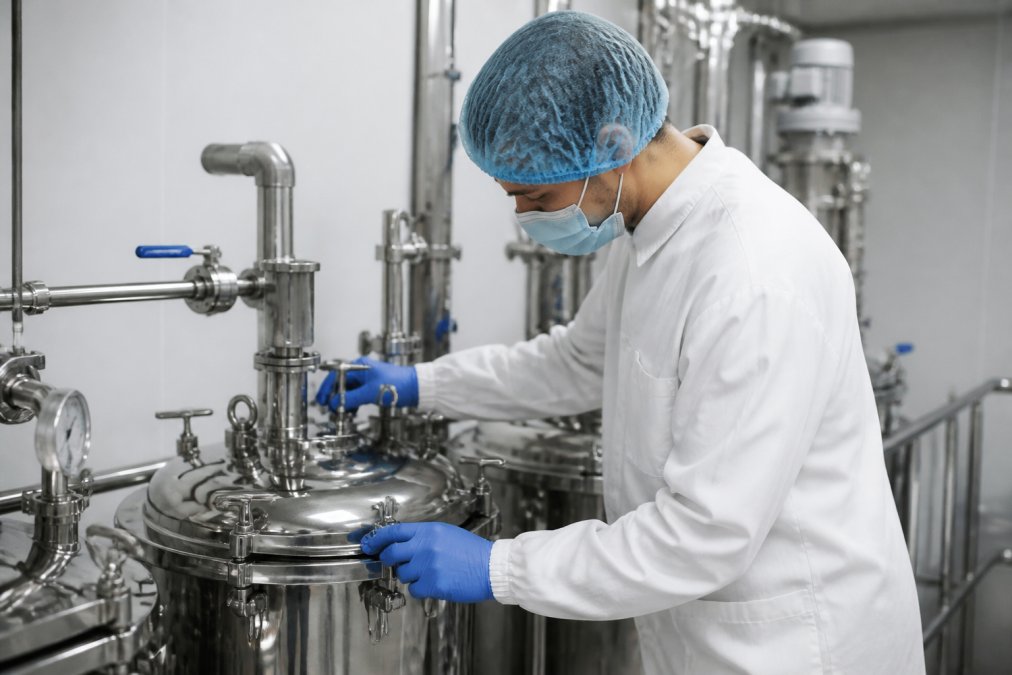
Facility design and environmental monitoring. Production areas must minimize contamination risks with controlled air handling, sanitizable surfaces, and monitoring programs for particulate and microbial levels. Without demonstrated environmental control, batch-to-batch consistency cannot be guaranteed.
Equipment qualification and calibration. Every piece of equipment that touches the product or influences quality must be qualified for its intended use and calibrated at defined intervals, including analytical instruments used for release testing.
Personnel training and documentation. All staff must be trained on the specific procedures they perform, with training records maintained. Documentation is the backbone of cGMP; if it was not written down, it did not happen.
Raw material sourcing and quality control. Incoming materials must be tested or verified against specifications before use, and suppliers must be qualified. A change in raw material source can silently alter product characteristics.

The presence of a cGMP framework does not guarantee a perfect product, but its absence guarantees that you cannot verify why a batch failed when something goes wrong.
Why ISO/IEC 17025 Third-Party Testing Matters
ISO/IEC 17025 third-party testing is the gold standard for laboratory competence verification and an independent check on a manufacturer’s quality claims.
A manufacturer testing its own products is analogous to a student grading their own exam; the potential for bias is inherent.
For your research documentation, this matters in practical terms. When you publish findings or defend your methodology before an institutional review board, the ability to state that your compounds were verified by an ISO/IEC 17025 certified laboratory strengthens the credibility of your entire experimental pipeline. As outlined in ISO guidance on conformity assessment, this certification provides a globally recognized benchmark for technical competence.
Verifying Quality with HPLC and Mass Spectrometry Analysis
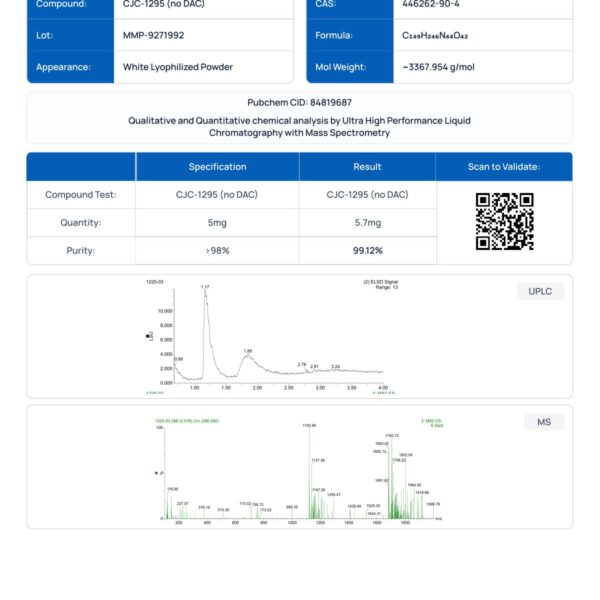
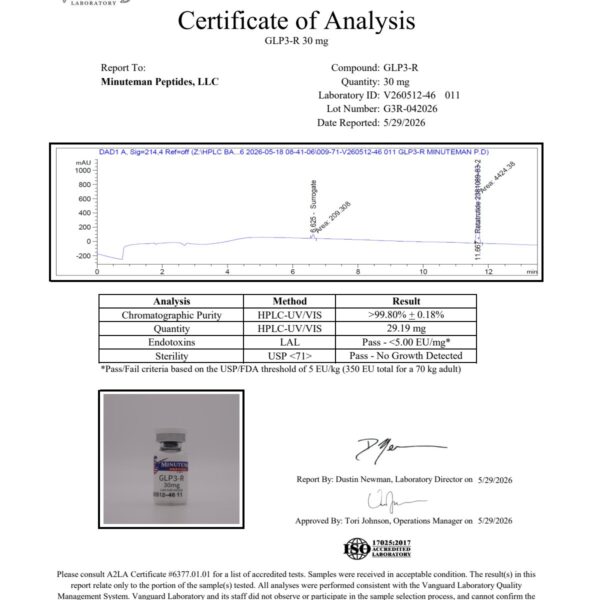
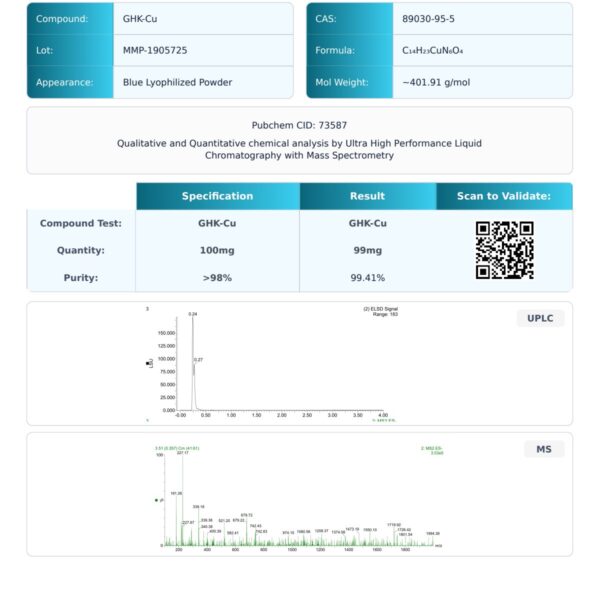
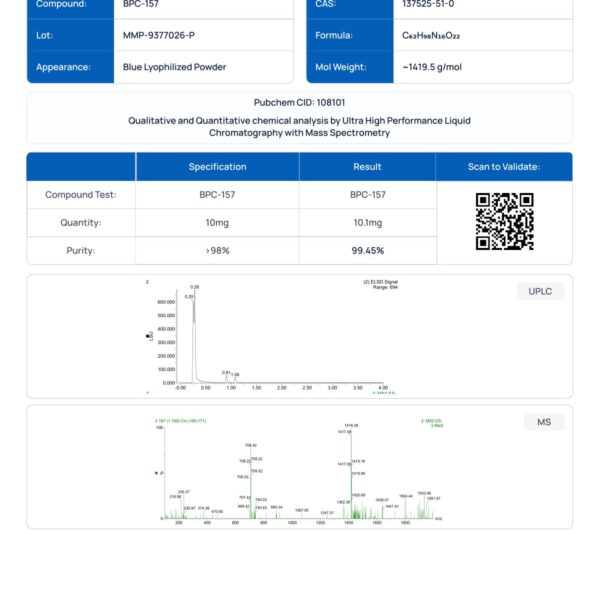
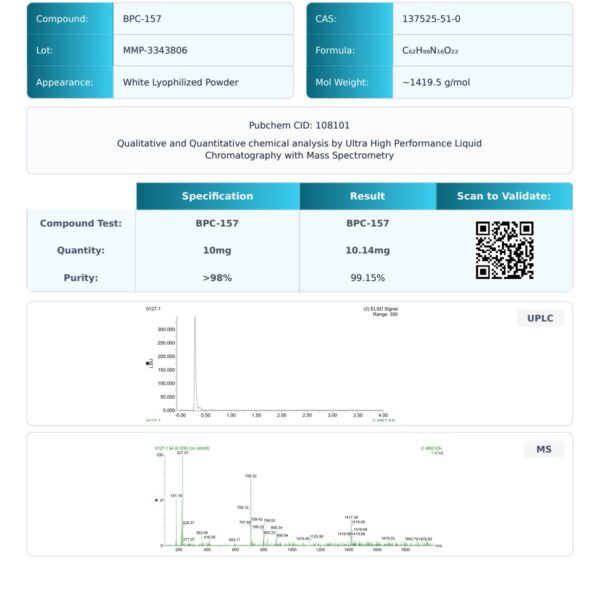
High-performance liquid chromatography (HPLC) and mass spectrometry translate quality claims into verifiable data. HPLC separates peptide components and quantifies the target sequence versus impurities, while mass spectrometry confirms molecular identity by measuring precise mass.
A certificate of analysis should report HPLC purity and observed mass compared to theoretical mass. Discrepancies indicate truncation, oxidation, or other modifications that can alter biological activity. A peptide with the wrong molecular weight will not bind its intended receptor, and your experiment will fail for reasons unrelated to your hypothesis.
What most guides miss is that single-test results are insufficient. Batch-to-batch consistency requires that the analytical methods themselves be validated and that the testing laboratory demonstrates ongoing proficiency. Research from National Institute of Standards and Technology guidance on analytical method validation emphasizes that method validation ensures the analytical procedure is suitable for its intended purpose and produces reliable results across different operators and instruments.
A purity claim without accompanying chromatographic data is just a marketing statement. Always request the actual HPLC trace and mass spectrometry report, not merely a summary percentage.
Transitioning from Research Use Only to cGMP-Grade Materials
Moving from research use only (RUO) reagents to cGMP-grade materials is a strategic decision many laboratories postpone until a crisis forces the issue. The transition becomes necessary when preliminary findings show promise and you need reproducible results across batches for a publication, grant application, or move toward clinical trial material.
While the per-vial price is higher, the cost of repeating a failed experiment, labor, reagents, instrument time, frequently exceeds the premium. Factoring in delayed publications and retraction risk, the economics become clear.
A supplier manufacturing under cGMP in a US-based facility offers shorter lead times and greater regulatory oversight than overseas alternatives.
A Practical Roadmap for the Transition
Phase 1: Define your trigger event. The transition is usually triggered by a specific milestone: a manuscript rejection questioning compound characterization, a grant requiring toxicity or stability data, a patent filing needing reproducible batch data, or a partnership with a clinical collaborator requiring GMP-grade material. Identify your trigger before shopping for suppliers, as it determines how much documentation you will need.
Phase 2: Conduct a gap assessment of your current data. Document what you know about your compound: HPLC traces from every batch, mass spectrometry confirmation, stability data. If your current supplier cannot provide raw analytical data, your historical data may not be defensible and your new supplier will need to establish a baseline. Most researchers discover they have relied on summary purity percentages without requesting underlying chromatograms, a painful discovery better made before a publication is under review.
Phase 3: Run a side-by-side comparability study. You cannot assume RUO and cGMP-grade products are interchangeable. Differences in manufacturing, salt form, counterion, residual solvent profile, peptide content, can alter solubility, stability, and bioactivity. Acquire both versions, run your key assay with both, and compare dose-response curves, solubility, and stability. Document any differences before committing to long-term studies.
Phase 4: Establish a qualified supplier relationship. Evaluate suppliers against four criteria: manufacturing location, quality systems documentation, analytical verification, and change notification practices. A supplier who commits to notifying you of any manufacturing process change, even a raw material source change, protects your experimental continuity. Silent changes can invalidate months of work.
When cGMP Is Overkill, and When It Is Not
For early-stage discovery work, target identification, initial screening, proof-of-concept studies, high-quality non-GMP material from a reputable manufacturer is often sufficient, provided the manufacturer documents batch-to-batch consistency and provides full analytical data.
The calculus shifts when your data will be used for regulatory submissions, when comparing results across multiple laboratories, or when generating stability data for an IND application. In those contexts, cGMP is a legal and regulatory requirement. Using RUO material in a study that later becomes part of a regulatory package can create data integrity questions difficult to resolve retroactively.
Investigators often use RUO material for early mechanism studies, then switch to cGMP for IND studies. The FDA may ask whether early studies used material representative of the clinical batch. If RUO and cGMP materials differ in purity or impurity composition, the agency may question the early data’s relevance. A comparability study at the transition point bridges that gap.
Cost-Benefit Framework for Early-Stage Research
For compounds early in the pipeline that may never advance, the cGMP premium is hard to justify. For compounds with a clear path toward clinical development, cGMP-grade material is often less than 1% of the cost of a single toxicology study.
A practical heuristic: if your compound has shown reproducible activity in at least two independent assay systems and you plan to publish or file a patent within 12 months, transition to cGMP-grade material now. Transition lead time, typically 4 to 8 weeks for a qualified supplier, is shorter than most expect. The bottleneck is your own documentation and comparability work.
Start the supplier qualification process before you need the material. Request samples, evaluate their certificate of analysis format, ask about change notification policies, and run a test batch through your assays. By the time you actually need cGMP-grade material, you will already know which supplier can deliver, and you will avoid the panic of qualifying a new vendor while a grant deadline looms.
The Documentation You Will Need to Build
Transitioning to cGMP-grade material is about building a documentation trail. At minimum, maintain: the certificate of analysis for every batch, including HPLC trace and mass spectrometry report; the supplier’s batch number and manufacturing date; your storage and handling logs; and comparability data between RUO and cGMP batches. This documentation evidences that your material was consistent, pure, and appropriately characterized.
Institutional review boards and journal reviewers increasingly ask for this level of compound characterization. Journals such as the Journal of Biological Chemistry and Nature have strengthened reporting requirements for chemical reagents, and funding agencies are following suit. Building this documentation habit now protects you against future requirements.
The transition from RUO to cGMP is not a single purchase decision; it is a process that involves defining your trigger, assessing your current data, running comparability studies, qualifying suppliers, and building a documentation trail. Laboratories that treat this as a deliberate, phased process, rather than a last-minute scramble, protect their research investment and position themselves for smoother regulatory interactions down the line.
Conclusion: Building a Reproducible Research Foundation
The integrity of your research depends on the quality of your inputs, and cGMP manufacturing standards provide the most reliable framework for ensuring that quality. From FDA oversight to ISO/IEC 17025 testing and verified HPLC and mass spectrometry analysis, each verification layer reduces the risk that contaminated or inconsistent compounds will compromise your findings.
At Minuteman Peptides, we source our research compounds from cGMP-certified US-based manufacturing facilities and verify every batch through independent ISO/IEC 17025 certified third-party testing, with results transparently documented in our certificates of analysis. This commitment to quality management and data integrity ensures that when your results point to a conclusion, you can trust that the compounds you used were not the source of variability. Get started with Minuteman Peptides and build a research foundation where reproducibility is the default, not the exception.
Frequently Asked Questions
What is the difference between cGMP and standard laboratory-grade manufacturing?
Standard laboratory-grade (reagent grade) manufacturing focuses on chemical purity for general lab use. cGMP manufacturing standards enforce stricter controls over the entire process, including facility design, equipment validation, personnel training, and documentation. For research compounds, cGMP-grade materials provide traceability and batch-to-batch consistency that reagent grade often lacks.
Are FDA cGMP requirements mandatory for research compounds?
If the research compound is intended for use in clinical trials or as part of an investigational new drug application, FDA cGMP requirements under 21 CFR 210 and 211 apply. For basic in-vitro research, these standards are not legally mandatory, but many researchers choose cGMP-certified suppliers to ensure higher data integrity and reproducibility.
How does ISO/IEC 17025 third-party testing verify a supplier’s claims?
ISO/IEC 17025 certification means an independent laboratory has been audited for technical competence. When a supplier uses such a lab for third-party testing, it provides an unbiased check on their internal quality control. This reduces the risk of a supplier only reporting favorable results from in-house tests.
Why is HPLC and mass spectrometry analysis important for peptide research?
HPLC analysis confirms the chemical purity of a peptide, while mass spectrometry verifies its molecular weight and identity. Together, they ensure you are working with the correct compound at the claimed purity level. This is critical for experimental repeatability, as impurities or misidentified compounds can invalidate assay results.
What should I look for on a Certificate of Analysis (COA) for research peptides?
A reliable COA should include the specific batch number, the date of manufacture, results from HPLC purity testing, and mass spectrometry data confirming molecular weight. It should also show results from an independent ISO/IEC 17025 certified laboratory. This documentation provides the traceability needed for consistent, repeatable experiments.
How do I ensure consistent results across multiple batches of a research compound?
To ensure consistency, select a supplier that follows cGMP manufacturing standards, as these require strict process controls and documentation. Always request the Certificate of Analysis for each batch and compare the purity and mass spec data. This allows you to confirm that quality parameters remain stable across different production runs.
This article was written using GrandRanker