
Table of Contents
- Solid Phase Peptide Synthesis: Where Quality Begins
- Peptide Purity Standards: What the Numbers Actually Mean
- HPLC vs Mass Spectrometry for Peptides: Complementary Methods
- How to Read COA Documents Without Getting Fooled
- Purification Techniques and Managing Diastereomeric Products
- QC Reporting Templates, Instrument Selection, and Nitrosamine Risk
- Batch Consistency and Stability Testing for Long-Term Studies
- Conclusion
- Frequently Asked Questions
Last Updated: September 30, 2026
Solid Phase Peptide Synthesis: Where Quality Begins
Peptide synthesis quality control methods begin at the resin, not the finished vial. Solid phase peptide synthesis (SPPS) builds a chain anchored to an insoluble resin bead, adding one amino acid at a time from C-terminal to N-terminal. Every coupling and deprotection step introduces errors that compound across the sequence.
Peptide Purity Standards: What the Numbers Actually Mean
Peptide purity standards describe the percentage of the target sequence relative to all other material in a sample. A 98% specification means 2% consists of deletion sequences, truncated peptides, or other impurities, a figure that matters enormously in sensitive assays.
Crude vs. Purified Peptide Quality
Crude peptide contains the target sequence plus every synthesis byproduct. Typical crude purity for a 20-mer runs 50-70%, depending on sequence difficulty. Purification removes most impurities, but starting crude quality determines recovery.
Ordering crude peptide for receptor-binding studies introduces deletion sequences that can act as partial agonists or antagonists. The resulting data will not replicate, and you will spend weeks troubleshooting an assay that was never going to work.
HPLC vs Mass Spectrometry for Peptides: Complementary Methods
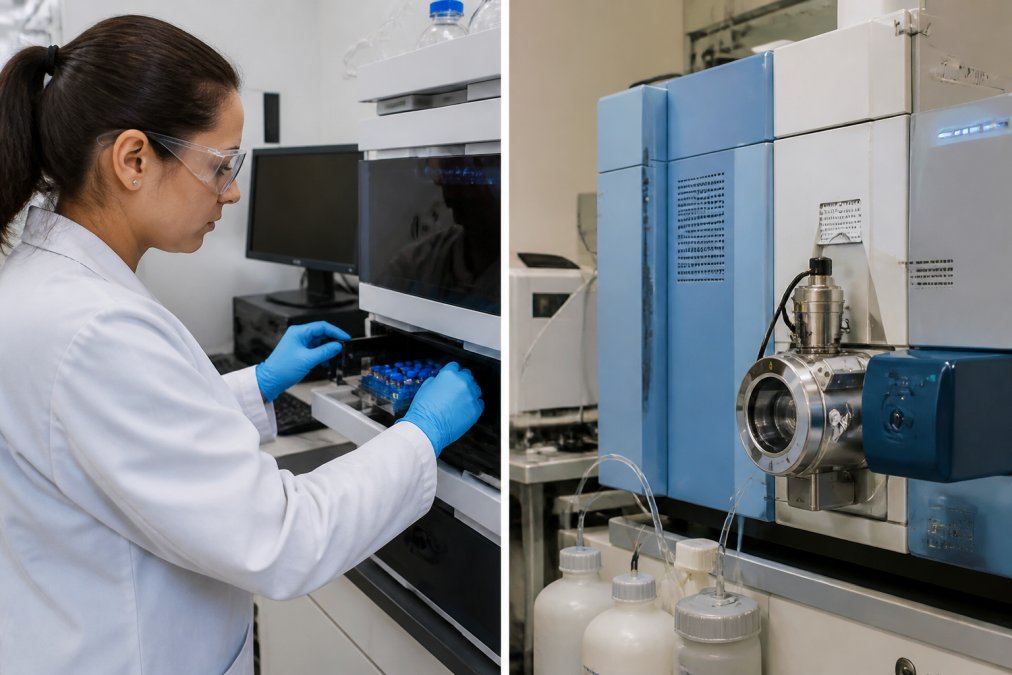
HPLC and mass spectrometry answer different questions. HPLC separates components by hydrophobicity and reports how much of the sample elutes as the target peak; mass spectrometry identifies those peaks by mass-to-charge ratio.
What Each Method Detects (and Misses)
HPLC detects everything absorbing at the chosen wavelength, typically 214 nm for the amide backbone, but cannot identify peaks. Mass spectrometry identifies molecular species with high confidence but gives no quantitative purity without chromatographic separation.
Request the full chromatogram with retention time and peak integration data, not just the purity percentage. A supplier who only reports “98% purity” without showing the trace is asking you to trust a number you cannot verify.
How to Read COA Documents Without Getting Fooled
A certificate of analysis is only as good as the laboratory that produced it. Reading COA documents requires checking who tested, what methods they used, and whether results match the claimed specifications.
What a Compliant CoA Must Contain
Most suppliers treat the certificate of analysis as a marketing artifact. A defensible CoA is a structured record, and the fields below are the minimum needed to reproduce or challenge a result. Use this as a checklist for new suppliers and a template for internal QC documentation.
Product and batch identification
- Peptide name, sequence (single-letter code), and molecular formula
- Lot or batch number traceable to a specific synthesis run
- Manufacturing date and testing date (testing must follow manufacturing)
- Quantity, physical form (lyophilized powder, solution), and storage recommendation
Analytical results, with method parameters
- Purity percentage by RP-HPLC, with detection wavelength (typically 214 nm), column dimensions and particle size, mobile phase composition, gradient program, flow rate, and run time
- Retention time of the main peak, plus the full chromatogram or a peak table listing each integrated peak and its area percentage
- Mass spectrometry result showing both expected and observed mass, ionization mode (ESI or MALDI), and the calculated versus found m/z
- Counter-ion identity and content (commonly trifluoroacetate), measured by ion chromatography
- Water content by Karl Fischer titration, and acetate or chloride content where relevant
Identity and traceability
- Testing laboratory name, physical address, and accreditation body
- Accreditation certificate number and scope (the specific test methods covered)
- Name and signature of the analyst or reviewer who released the result
- Method references (USP chapters, in-house SOP numbers, or validated protocols)
Supplementary data where applicable
- Amino acid analysis for composition confirmation
- Peptide content (net peptide versus counter-ion and water mass), this figure, not the gross weight, determines how much material you actually have
- Sterility or endotoxin results for any material intended for cell culture
Red Flags in a Certificate of Analysis
Watch for these warning signs:
- Purity reported without the analytical method or wavelength
- No retention time or peak integration data
- Mass spectrometry results without the expected versus observed mass
- Testing dates that predate the manufacturing date
- No lot number traceable to a specific synthesis batch
- Accreditation claims without a certificate number
- A single purity figure with no chromatogram attached
- Peptide content omitted, so the net weight is unknown
The single most important line on any COA is the testing laboratory’s name and accreditation status. If the supplier tested their own product and signed their own certificate, you have a marketing document, not an analytical result. Build a standard intake template that captures every field above, and require it before a batch enters your inventory.
Purification Techniques and Managing Diastereomeric Products
Preparative reverse-phase HPLC remains the standard purification method for most research peptides. The crude peptide dissolves in a compatible solvent, loads onto a C18 column, and elutes with an acetonitrile/water gradient using trifluoroacetic acid as the ion-pairing agent, separating target from deletion sequences and truncated fragments.
Counter-ion exchange after purification changes the peptide’s solubility and stability. Skipping this step because the trifluoroacetate salt “looks fine” often leads to aggregation during lyophilization and inconsistent reconstitution later.
QC Reporting Templates, Instrument Selection, and Nitrosamine Risk
Three topics separate a serious QC program from a checkbox exercise: comparing analytical instruments, documenting results consistently, and managing nitrosamine risk.
Comparative Analysis of Analytical Instruments for Peptide Validation
HPLC, mass spectrometry, and NMR each answer a different question, and the instrument and its configuration change the number you report.
RP-HPLC (reverse-phase high-performance liquid chromatography)
- Separates by hydrophobicity; reports quantitative purity as peak area percentage
- Detection at 214 nm captures the amide backbone; 220 nm and 280 nm (for aromatic residues) are common alternatives
- Key variables: column chemistry (C18 vs C8), particle size (3 µm vs 5 µm), gradient slope, column temperature, and detector linearity
- Strength: quantitative, reproducible, and the industry standard for purity claims
- Limitation: cannot identify what a peak is; co-eluting deletion sequences can inflate the purity figure
Mass spectrometry (ESI or MALDI)
- Confirms molecular identity by measuring mass-to-charge ratio against the expected molecular weight
- ESI couples directly to LC for LC-MS; MALDI is faster for high-throughput confirmation
- Key variables: ionization efficiency (sequence-dependent), calibration standard, and mass accuracy (typically within 0.1% of expected mass)
- Strength: definitive identity confirmation and detection of truncations or modifications
- Limitation: no quantitative purity without chromatographic separation; blind to diastereomers, which share the same mass
NMR spectroscopy
- Provides structural confirmation and can distinguish diastereomers that HPLC and MS cannot resolve
- One-dimensional ¹H NMR confirms the presence of expected functional groups; two-dimensional experiments (COSY, TOCSY) resolve sequence-specific connectivity
- Key variables: solvent (D₂O or DMSO-d₆), field strength, and referencing standard
- Strength: the only routine method that directly detects stereochemical errors
- Limitation: lower sensitivity than HPLC or MS, requires more material (milligram quantities), and is slower, rarely used for routine batch release
Standardized QC Reporting Templates
A reporting template solves a problem most labs recognize too late: comparing results across suppliers and batches when every certificate uses different formats and terminology. Capturing retention time, peak area percentage, observed mass, method parameters, and peptide content creates a consistent, auditable record.
At minimum, your internal template should log:
- Batch identifier and supplier lot number
- Purity percentage, method, wavelength, and column details
- Retention time and full peak table
- Expected versus observed mass and ionization mode
- Counter-ion and water content
- Peptide content (net peptide)
- Testing laboratory name and accreditation number
- Date received, date tested, and analyst initials
Risk Mitigation for Nitrosamine Impurities
Nitrosamine risk has become a central concern in pharmaceutical quality control. The FDA guidance on nitrosamine impurities in drug products outlines control strategies that research peptide suppliers should understand even when their products are not drug substances.
Nitrosamine formation requires two ingredients: a secondary amine (or a precursor that forms one) and a nitrosating agent such as nitrite. In peptide synthesis, the risk points are specific:
- Resin and reagent impurities, residual dimethylamine or diethylamine from coupling reagents or resin cleavage cocktails
- Solvent quality, DMF and other amide solvents can degrade to release dimethylamine under acidic or elevated-temperature conditions
- Cleavage cocktails, TFA-based cleavage with scavengers can concentrate amine precursors if the cocktail is not fresh
- Water and buffer sources, trace nitrite in water or buffers can react with free amines during workup
Mitigation starts upstream:
- Screen raw materials and solvents for secondary amine and nitrite content before use
- Use fresh cleavage cocktails and avoid holding crude peptide in acidic solution longer than necessary
- Purify early, reverse-phase HPLC removes many low-molecular-weight amine impurities before they can react further
- Test finished material for nitrosamine content when the sequence or process presents elevated risk
- Document the risk assessment so it can be reviewed if regulations tighten
Nitrosamine risk is sequence- and process-dependent, not universal. A peptide with no secondary amine precursors and a clean solvent supply carries low risk, but the assessment must be documented, not assumed.
Batch Consistency and Stability Testing for Long-Term Studies
Batch consistency determines whether your 18-month study produces comparable data from month one to month eighteen. A supplier delivering 98% purity on the first order and 94% on the third has broken your experiment, even if both batches meet a loose specification.
| QC Parameter | Method | What It Confirms | Frequency |
|---|---|---|---|
| Purity | HPLC at 214 nm | Target peak percentage | Every batch |
| Identity | Mass spectrometry | Correct molecular weight | Every batch |
| Counter-ion | Ion chromatography | TFA content | Every batch |
| Water content | Karl Fischer titration | Lyophilization completeness | Every batch |
| Stability | Accelerated and long-term | Degradation profile | Per product line |
Conclusion
The gap between a peptide that works and one that quietly ruins six months of research is usually not the sequence. It is the quality control behind it. Build your supplier evaluation around verified third-party testing, readable COAs, and batch-to-batch consistency data. Minuteman Peptides provides cGMP-certified manufacturing, independent ISO/IEC 17025 accredited testing, and transparent certificates of analysis with verified HPLC and mass spectrometry results for every lot.
Frequently Asked Questions
What are the standard quality control methods for synthetic peptides?
The core methods are high-performance liquid chromatography (HPLC) for purity assessment and mass spectrometry for molecular weight confirmation. HPLC separates the target peptide from impurities and reports purity as a percentage of peak area. Mass spectrometry verifies the mass-to-charge ratio matches the expected amino acid sequence. Together they confirm identity and purity. Additional methods include amino acid analysis, counter-ion exchange testing, and lyophilization checks. For research-grade peptides, independent ISO/IEC 17025 certified third-party testing adds a layer of verification beyond in-house results.
How do I interpret a Certificate of Analysis for peptides?
Start with the batch number and test date to confirm the COA matches your vial. Check the HPLC purity percentage and the method used (column type, gradient elution, wavelength). Verify the mass spectrometry result shows the correct molecular weight. Look for the testing laboratory’s name and ISO/IEC 17025 certification. A thorough COA includes chromatograms and spectra, not just summary numbers. If a COA lists only a purity percentage without raw data or method details, treat it as incomplete.
Why are HPLC and mass spectrometry both needed for peptide purity verification?
HPLC measures purity by separating components in a sample and calculating the percentage of the target peak. It can miss peptides with the same retention time but different molecular structures, such as diastereomeric products. Mass spectrometry confirms the molecular weight matches the expected sequence, catching sequence errors or truncations that HPLC alone cannot detect. Using both methods together gives you a complete impurity profile and confirms both identity and purity.
What is the difference between crude and purified peptide quality?
Crude peptides come directly from synthesis with typical purity between 60-80%. They contain deletion sequences, truncated peptides, and residual reagents. Purified peptides undergo HPLC purification to reach 95% or higher purity, depending on the grade. For metabolic pathway research or cellular signaling studies, purified peptides with verified COAs are essential for repeatable results. Crude peptides may be acceptable for initial screening but not for quantitative experiments where batch consistency matters.
How does ISO/IEC 17025 certification affect peptide research reliability?
ISO/IEC 17025 certification means the testing laboratory has demonstrated technical competence and operates under a quality management system audited by an accreditation body. When your peptide supplier uses an ISO/IEC 17025 certified lab for third-party testing, the analytical results carry more weight than in-house data alone. You can verify a lab’s accreditation status through the accrediting body’s public directory. This matters when your research requires documented, traceable quality evidence for publication or regulatory review.
What should I look for in a peptide COA to avoid quality problems?
Look for these items: batch-specific HPLC chromatogram with retention time and peak integration data, mass spectrometry spectrum with mass-to-charge ratio, the analytical method description (column, solvent, gradient elution), testing laboratory name and certification, and a purity percentage backed by raw data. Red flags include COAs that show only a single purity number without supporting chromatograms, missing batch numbers, or results that reference a different lot. Request a sample COA before committing to a multi-batch order.


