

Table of Contents
- What Makes Peptides Low Quality
- Physical Identification of Low Quality Peptides
- How to Read COA Documents for Purity Verification
- Third-Party Peptide Testing and Verification Standards
- Signs of Peptide Degradation During Storage
- Risks of Unapproved and Counterfeit Peptides
- Ensuring Research Integrity Through Supplier Verification
- Frequently Asked Questions
Last Updated: September 22, 2026
What Makes Peptides Low Quality
Low quality peptides compromise research integrity and fail to deliver accurate, repeatable results.
Low quality peptides are compounds that fall short of purity standards, lack proper documentation, or contain contaminants. They may be improperly stored, poorly manufactured, or sourced from facilities without rigorous quality controls. When your research depends on consistent, pure compounds, substandard peptides introduce variables you cannot control.
Experiments fail, data becomes unreliable, and months of work can be invalidated by a single batch of compromised material.
Low quality peptides introduce contamination, inconsistency, and failed experiments. Verification through testing and documentation is your only defense.
Physical Identification of Low Quality Peptides
Visual inspection catches obvious problems that indicate deeper quality issues.
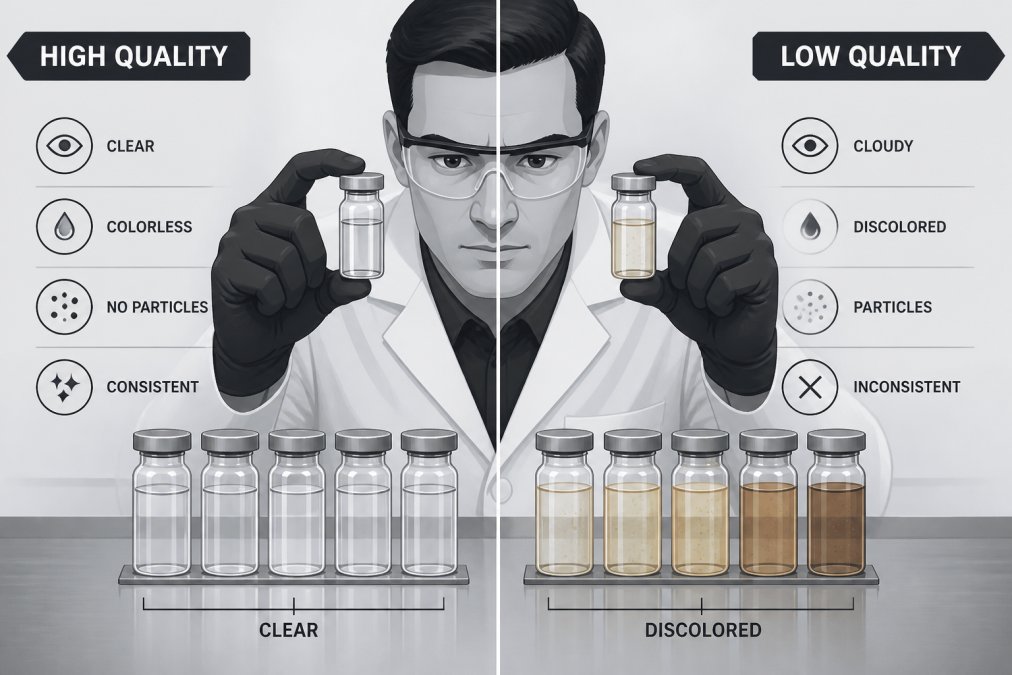
High-quality peptide powder should be white, off-white, or pale yellow. Discoloration, brown, gray, or dark spots signal degradation or contamination. Clumping or caking suggests moisture exposure or improper storage.
Check the vial itself. Cracks, cloudiness in glass, or damaged seals indicate the compound has been exposed to air or moisture. A compromised vial means the peptide inside is compromised.
Large crystals or uneven texture can indicate improper reconstitution or storage temperature fluctuations; fine, uniform powder is the standard.
A strong chemical or off odor suggests contamination or decomposition; quality peptides have minimal odor.
These physical signs flag problems and serve as your first line of defense.
Discoloration, clumping, or damaged vials are red flags for degradation. Do not use peptides that fail basic visual inspection, testing costs less than repeating failed experiments.
How to Read COA Documents for Purity Verification
A Certificate of Analysis is your proof of quality. Learning to read it correctly, and verify it is genuine, separates legitimate suppliers from those cutting corners.
Certificates of Analysis (COAs) document purity testing results for a specific batch. A real COA is your guarantee; a fake or incomplete COA is a major warning sign.
Verify the Lab’s Credentials First
Before you read the numbers, confirm the testing lab is real and accredited. This is the single most important step.
Search for the lab’s ISO/IEC 17025 accreditation on the ILAC database or the accrediting body’s website (A2LA or ANAB in the US). If you cannot find the lab listed, the accreditation is expired, false, or the lab does not exist.
Verify the accreditation scope explicitly covers HPLC, Mass Spectrometry, or the specific method used. Vague scope language means testing may not meet the claimed standard.
Verify the accreditation expiration date; accreditation renewed every two to three years. Do not accept COAs from labs with expired accreditation.
Spot Red Flags in COA Format and Content
Generic or template COAs lack batch-specific data. If the COA shows identical purity percentages across multiple batches, it is likely a template, not a real test result.
The COA should explicitly state “HPLC” and “Mass Spectrometry” or “LC-MS.” Vague language like “tested for purity” or “analyzed by standard methods” indicates insufficient rigor.
A quality COA lists water content (typically 1-5% for lyophilized peptides), residual solvents (acetonitrile, trifluoroacetic acid), and related impurities. If the COA says “purity 95%” but does not explain the other 5%, you do not know what contaminants are present.
A COA should mention the reference standard used (e.g., “calibrated against USP or pharmacopeial standard”). Absence of this detail suggests the lab did not follow validated procedures.
Read the Numbers Correctly
Purity should be 95% or higher for research-grade peptides; anything below 90% is poor quality. However, you must also know what the impurities are.
Water content above 5% indicates moisture absorption and improper storage; high water content accelerates degradation.
Residual solvents (acetonitrile, trifluoroacetic acid, methanol) should be listed by name and concentration in ppm. Acetonitrile is typically below 5,000 ppm, trifluoroacetic acid below 1,000 ppm. If not listed separately, ask the supplier why.
A quality COA lists top impurities by name and percentage. If the COA lists only “total impurities: 5%” without breakdown, you cannot assess whether impurities are harmless or problematic.
Endotoxin testing (EU/mg) is critical for peptides used in cell culture or in vivo work. Acceptable levels are typically below 100 EU/mg. If not listed and your research involves cells or animals, request it.
Cross-Check the COA Against Your Vial
Batch numbers on the COA and vial must match exactly.
A COA dated more than six months before receipt raises questions about storage conditions; recent testing (within one to two months of shipment) is better.
Verify molecular weight and compound name match your order; typos suggest the COA does not belong to your batch.
Demand COAs with HPLC and Mass Spectrometry results, batch-specific data, third-party lab accreditation verified independently, and detailed breakdown of water content, residual solvents, and impurities. Generic COAs, missing lab credentials, or vague testing methods are red flags for low quality peptides.
Third-Party Peptide Testing and Verification Standards
Independent testing removes conflicts of interest and provides objective proof of quality.
Third-party peptide testing means an outside laboratory performs purity analysis, eliminating incentive to overstate results. ISO/IEC 17025 certification ensures strict international standards for accuracy and consistency.
HPLC analysis measures the percentage of desired compound versus impurities. Mass Spectrometry confirms molecular weight and identifies unexpected compounds.
Ask your supplier who performs testing. If they name themselves, that’s in-house testing, not independent. Real third-party labs are separate entities with their own ISO/IEC 17025 accreditation.
Verify the certification is current and covers the specific testing methods used. If you cannot find the scope of accreditation, the certification may be outdated or incomplete.
Better labs test for related impurities, water content, and endotoxins; more comprehensive testing catches problems that simple purity checks miss.
If you order the same peptide twice, testing should show consistent results. Extreme batch-to-batch variation signals poor manufacturing controls.
Signs of Peptide Degradation During Storage
Even stored peptides degrade over time. Knowing the signs helps you catch problems before they affect your research.
Heat, light, humidity, and air exposure break down peptide structure, producing impurities that compromise results and reduce potency.
Temperature and Degradation Rate
Temperature is the biggest factor controlling degradation speed; for every 10°C increase, degradation rate roughly doubles.
Peptides stored at room temperature (20-25°C) lose measurable potency within weeks to months. Disulfide-bonded peptides and those containing methionine or tryptophan degrade faster due to oxidation sensitivity.
Refrigerated storage (2-8°C) slows degradation. Lyophilized peptides at 4°C remain stable for months, though moisture absorption is a concern in humid environments.
Frozen storage (below −20°C) is the standard for long-term stability. Peptides frozen at −20°C remain stable for one to two years with minimal potency loss. If stored unrefrigerated, degradation has already begun.
Moisture Absorption and Visual Signs
Lyophilized peptides absorb water from humid air, triggering multiple degradation pathways.
Yellowing indicates oxidation from moisture and air exposure. Brown or gray discoloration signals advanced degradation or contamination.
Clumping indicates moisture absorption and signals that water content has risen enough to trigger chemical degradation. Do not use clumped peptides.
If powder sticks to vial walls, clumps when tapped, or requires vigorous shaking, moisture has been absorbed.
If the desiccant packet has changed color (blue to pink), it has absorbed moisture from inside the vial, indicating peptide exposure to humidity.
Light Exposure and Oxidation
Light exposure causes oxidation, especially in peptides containing aromatic or sulfur-containing amino acids.
Peptides in clear glass vials degrade faster than those in amber vials.
Reconstituted Peptides and Solution Stability
Reconstituted peptides in water or aqueous buffers remain stable for three to five days at 4°C. Beyond that, bacterial growth and oxidation become concerns.
Batch Age and Expiration
Typical shelf life for lyophilized peptides stored properly is two to three years from manufacture. After two years, purity may decline by 5-10%; after three years, degradation accelerates.
How to Test for Degradation Without a Lab
Reconstitute a small amount in your standard solvent. Quality peptides dissolve quickly and completely. Slow dissolution, clumping, or residue indicates degradation or contamination.
Peptides stored at room temperature, in humid conditions, or in clear vials under light degrade faster. Discoloration, clumping, loss of flowability, or desiccant color change indicate degradation has begun. Do not use degraded peptides in research.
Risks of Unapproved and Counterfeit Peptides
Counterfeit and untested peptides pose serious risks to your research and safety.
Ensuring Research Integrity Through Supplier Verification
Start with documentation. Ask for:
- Third-party testing credentials (ISO/IEC 17025 certification)
- COAs for every batch
- Batch-specific testing data (not generic templates)
Verify certifications independently. Don’t accept supplier claims alone. Look up ISO/IEC 17025 accreditation on the accrediting body’s website. Confirm cGMP certification through official records.
Research institutions and biotech firms requiring guaranteed purity, batch-to-batch consistency, and transparent documentation for experimental repeatability.
Frequently Asked Questions
How can I tell if peptides are good quality?
Quality peptides display consistent appearance, come with verified Certificates of Analysis from ISO/IEC 17025 certified laboratories, and show HPLC and Mass Spectrometry results confirming purity levels. Reputable suppliers provide transparent documentation, maintain cGMP-certified manufacturing standards, and offer third-party testing results. Request batch-specific COAs and verify the testing laboratory’s credentials independently before accepting any shipment for your research.
How do I verify a Certificate of Analysis (COA) for peptides?
Check that the COA includes the testing laboratory’s ISO/IEC 17025 certification number and accreditation status. Verify the peptide’s molecular weight, sequence, and purity percentage match your order specifications. Confirm that HPLC chromatography data shows a single major peak above 95% purity, and that Mass Spectrometry results match the expected molecular ion. Contact the third-party testing lab directly to confirm they issued the COA, and cross-reference batch numbers with your supplier’s records.
What does third-party peptide testing involve?
Third-party peptide testing uses High-Performance Liquid Chromatography (HPLC) to measure purity and identify impurities, and Mass Spectrometry to confirm molecular weight and structure. ISO/IEC 17025 certified laboratories conduct independent testing on samples from each batch, ensuring results are unbiased and reproducible. Testing verifies that the peptide matches specifications.
What are the signs that peptides have degraded?
Degraded peptides show visible discoloration, cloudiness, or crystalline deposits in the vial. Peptides stored improperly may develop an off-odor or appear clumpy after reconstitution. HPLC analysis reveals multiple peaks instead of a single major peak, indicating breakdown of the peptide chain. If reconstitution takes longer than expected or the solution remains cloudy after proper preparation with sterile or bacteriostatic water, degradation has likely occurred. Always store peptides at the recommended temperature and verify expiration dates before use.


