

Table of Contents
- Why Purity and Repeatability Define Valid Research
- The Reproducibility Crisis and What It Costs Private Labs
- Peptide Batch Consistency for Research: The Foundation of Repeatable Results
- ISO/IEC 17025 Certified Peptide Testing: What It Actually Verifies
- NIH Rigor and Reproducibility Standards for Private Institutions
- Practical Implementation: Building a Reproducibility Framework
- Common Mistakes That Undermine Experimental Integrity
- Conclusion
- Frequently Asked Questions
Last Updated: October 1, 2026
Why Purity and Repeatability Define Valid Research
Research purity is the degree to which a compound matches its stated identity, concentration, and freedom from contaminants, and it is the single variable that determines whether your experimental results can be trusted. At Minuteman Peptides, we built our entire quality model around one observation: in growth and signaling pathway work, a small impurity does not produce a small error. It produces a different experiment.
The Reproducibility Crisis and What It Costs Private Labs
The reproducibility problem in biomedical research is well documented, and private institutions feel it more acutely than most. A landmark survey published in Nature found that a majority of researchers had failed to reproduce another scientist’s experiments, and roughly half had failed to reproduce their own. For a private lab, that failure is not an abstract concern about the state of science. It is a line item.
Where Irreproducibility Actually Originates
Most reproducibility failures are not caused by fraud or sloppiness. They cluster around a small number of controllable variables:
- Material variability. A different lot, a different counterion, or an unlisted impurity can shift a dose-response curve without any change to your protocol.
- Undocumented protocol drift. Small, unrecorded adjustments to timing, temperature, or buffer composition accumulate across experiments until the assay is no longer the same assay.
- Reagent authentication gaps. Antibodies, cell lines, and reference standards that are not verified against a known source introduce silent identity errors.
- Analysis flexibility. When the analysis pipeline is chosen after the data is seen, results become difficult to reproduce even by the original lab.
- Incomplete reporting. If a method section omits a variable that mattered, no independent lab can reconstruct the experiment.
The Real Cost Structure
A single unrepeatable result rarely stays contained. The direct costs include reagents consumed, instrument hours, and staff time spent on the failed replication. The indirect costs are larger and harder to recover: delayed milestones, grant or contract obligations that slip, and the credibility cost when a collaborator or funder learns that a reported finding could not be repeated.
Why Private Labs Are Exposed
Publicly funded academic labs often have institutional review boards, core facilities, and grant-reporting requirements that impose documentation discipline by default. Private labs frequently operate leaner, with fewer layers of review and more pressure to move quickly. That efficiency is a strength, but it removes the accidental safeguards that catch material and protocol drift. The fix is to build those safeguards deliberately rather than inherit them.
Reproducibility failures are usually caused by uncontrolled variables, and the most common uncontrolled variable in signaling pathway research is the material itself. Treat supplier qualification and lot documentation as risk management, not paperwork.
Peptide Batch Consistency for Research: The Foundation of Repeatable Results
Peptide batch consistency for research means that the compound you receive in month one performs identically to the compound you receive in month twelve, with the same purity profile, the same counterion, and the same measured mass. Without that consistency, your experiment changes every time you open a new vial, even when your protocol does not.
What Causes Batch-to-Batch Variation
Variation creeps in at several points. Incomplete coupling during synthesis leaves truncated sequences. Improper cleavage can damage side chains. Purification gradients that are not tightly controlled leave closely related impurities behind. Even lyophilization and packaging conditions affect how a peptide redissolves and behaves in assay.
Documentation That Proves Consistency
The document that proves consistency is the Certificate of Analysis, and it needs to do more than state a number. A useful COA ties a specific lot number to a specific chromatogram and mass spectrum, so you can verify the data rather than trust a summary.
ISO/IEC 17025 Certified Peptide Testing: What It Actually Verifies
ISO/IEC 17025 certified peptide testing verifies that the laboratory performing the analysis operates under a recognized quality management system with documented methods, calibrated instruments, and traceable results. The certification applies to the testing lab, not the vendor, which is why the distinction matters.
HPLC and Mass Spectrometry: Reading the Data
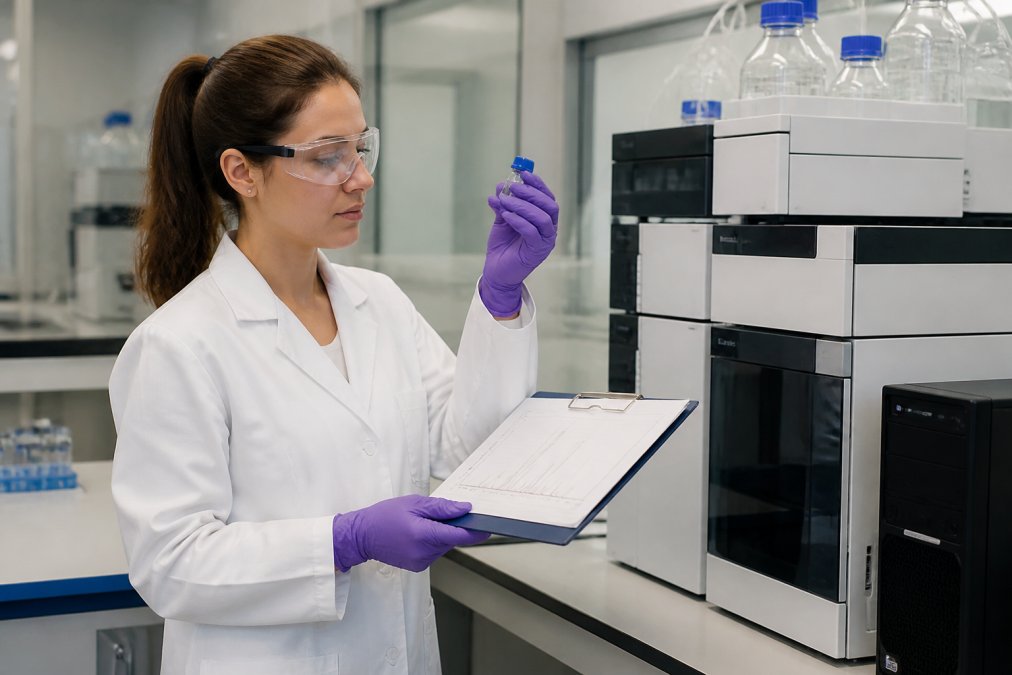
High-performance liquid chromatography (HPLC) separates the components of a sample by how they interact with a stationary phase, producing a chromatogram where each peak represents a distinct compound. A single sharp main peak with minimal shoulders indicates high purity; extra peaks indicate impurities.
NIH Rigor and Reproducibility Standards for Private Institutions
The NIH rigor and reproducibility standards establish expectations for experimental design, authentication of materials, and transparent reporting, and private labs that adopt them gain a ready-made framework for their own quality systems. The NIH guidance on rigor and reproducibility emphasizes scientific premise, careful experimental design, and clear reporting of variables.
Practical Implementation: Building a Reproducibility Framework
Most guidance on reproducibility stops at principles. For a private research institution, the useful question is operational: what does a working framework actually look like on a Tuesday afternoon, and who owns each step? The OECD Principles on Good Laboratory Practice offer a useful reference for documentation and traceability expectations that private labs can adapt without adopting a full regulatory apparatus.
A Tiered Implementation Model
Rather than a flat checklist, structure the framework in three tiers so effort scales with risk.
Tier 1, Material control (highest leverage).
- Qualify every supplier on documentation, not price. Request lot-specific Certificates of Analysis and confirm the testing lab’s ISO/IEC 17025 accreditation. A sample COA from a different lot tells you nothing about the vial in your hand.
- Log every lot number against the experiment it was used in. When a result fails to replicate, the first question should be answerable in minutes: which lot produced the original data?
- Retain reference samples from each lot. A retained aliquot lets you run a side-by-side comparison when a discrepancy appears, isolating material as the cause before you redesign the study.
Tier 2, Protocol and handling control.
- Standardize reconstitution and storage in writing. Handling differences alone can shift results, and verbal tradition does not survive staff turnover.
- Authenticate reagents and cell lines against a known source at intake, and record passage numbers for every experiment.
- Freeze the analysis plan before data collection where the study design allows it, so analysis choices are not made after seeing outcomes.
Tier 3, Review and traceability.
- Review data provenance at project milestones to catch drift before it compounds across a study.
- Report methods at a level of detail an independent lab could repeat. If a variable mattered, it belongs in the record.
Technology and Automation for Repeatability
Automation removes the human variability that creeps into repetitive steps. Automated liquid handling reduces pipetting variance across plates and operators. Barcode-tracked inventory ties each vial to its lot, receipt date, and storage location without manual transcription. Electronic lab notebooks that link lot numbers directly to experimental results make provenance queries instant rather than archaeological.
Cost-Benefit Analysis of Reproducibility Initiatives
Reproducibility work has a visible cost and an invisible payoff. The visible cost is upfront: qualified suppliers, documented protocols, retained reference samples, and staff time on record-keeping. The invisible payoff is the experiment you do not have to repeat.
When evaluating a new supplier, request the COA for the exact lot you will receive, not a sample COA. A vendor confident in batch consistency will provide it without hesitation.
A reproducibility framework that exists only as a document fails. Assign an owner for each tier, and audit lot-to-experiment linkage at least quarterly so the system stays live.
Common Mistakes That Undermine Experimental Integrity
The same errors appear across labs, and each one quietly erodes the value of your data. A common mistake is treating a purity percentage as a complete quality signal without checking the impurity profile. Another is accepting a generic COA that cannot be matched to your specific lot.
Storing peptides under inconsistent conditions between experiments introduces variability that no statistical method can correct. Establish one storage protocol and enforce it across every lot and every researcher.
Conclusion
The hardest part of reproducibility is not the science. It is maintaining discipline across every batch, every protocol, and every researcher over the full life of a study. Minuteman Peptides supports that discipline with cGMP-certified, US-based manufacturing and independent ISO/IEC 17025 certified third-party testing, verified by HPLC and Mass Spectrometry and documented in transparent Certificates of Analysis. If your signaling pathway work depends on material that behaves the same way every time, start with a supplier that treats purity as a specification, not a slogan.
Frequently Asked Questions
What are the NIH guidelines for rigor and reproducibility in research?
The NIH rigor and reproducibility standards require researchers to address experimental design, biological variables, and authentication of key resources in grant applications. Key elements include clearly stated hypotheses, appropriate statistical power analysis, randomization and blinding procedures, and detailed documentation of reagents and protocols. For private institutions studying signaling pathways, aligning with these standards strengthens both internal consistency and external credibility, even when not directly subject to federal grant requirements.
How does peptide purity affect signaling pathway experimental outcomes?
Impurities in research peptides can activate unintended pathways, suppress expected responses, or introduce confounding variables that make results difficult to interpret. A peptide with 95% purity may contain 5% of truncated sequences, deletion products, or residual solvents that interact with cellular targets differently than the intended compound. High research purity, verified through independent testing, ensures that observed effects trace back to the target molecule rather than contaminants. This directly supports unbiased results and methodological consistency across experiments.
Why is third-party ISO/IEC 17025 certified testing critical for research compounds?
ISO/IEC 17025 certification confirms that a testing laboratory meets international standards for competence, impartiality, and consistent operation. When a supplier’s peptide batch undergoes independent ISO/IEC 17025 certified peptide testing, the resulting Certificate of Analysis reflects data generated by a lab with no financial interest in the outcome. This independent verification provides documentation standards that support peer review, institutional oversight, and data provenance requirements. In-house testing alone cannot offer the same level of scientific authority.
What are the best practices for maintaining batch consistency in private research institutions?
Peptide batch consistency for research depends on several operational practices: sourcing from cGMP-certified manufacturers with documented standard operating procedures, requiring third-party HPLC and mass spectrometry verification for every lot, storing peptides under recommended conditions with proper aliquoting to avoid freeze-thaw cycles, and maintaining detailed records of lot numbers, handling dates, and experimental conditions. Institutions that implement protocol standardization and independent verification across batches reduce the risk of irreproducible results and strengthen the overall research culture.
Reproducible research begins with material you can trust. Minuteman Peptides provides the purity and repeatability that research settings demand, backed by cGMP-certified manufacturing, independent ISO/IEC 17025 certified testing, and verified HPLC and Mass Spectrometry results for every batch. Get started with Minuteman Peptides and give your experiments a foundation that holds up.


