

Table of Contents
- What a Certificate of Analysis Is and Why It Matters
- How to Verify Product and Sample Identification
- Matching the COA to Your Product Lot or Batch
- Understanding Laboratory Identity and Testing Information
- Reading HPLC Results Explained
- Interpreting Mass Spectrometry Peptide Testing
- A Peptide COA Example and How to Review It
- Red Flags and What a COA Cannot Establish
- Frequently Asked Questions
Last Updated: October 7, 2026
What a Certificate of Analysis Is and Why It Matters
A Certificate of Analysis (COA) is a laboratory document verifying the identity, purity, and quality of a research compound or peptide, and understanding how to read COA documents is essential for research integrity.
At Minuteman Peptides, we provide detailed COAs for every batch, giving you the data to confirm the product suits your experimental work.
Bad data in equals bad data out: a contaminated or mislabeled peptide compromises your study. A proper COA protects your research integrity by documenting exactly what you’re working with.
How to Verify Product and Sample Identification
The first thing to check on any COA is whether the product name and lot number match your order.
Look for these key identifiers:
- Product name: Should match exactly what you ordered (e.g., “Peptide XYZ-001”)
- Lot number or batch number: A unique identifier for that production run
- Sample date: When the laboratory received the sample for testing
Cross-reference these against your purchase order and shipping documentation. If anything doesn’t match, contact your supplier before using the product, a discrepancy is a red flag.
Matching the COA to Your Product Lot or Batch
Your peptide vial and your COA both carry a lot number. These must match exactly, that’s how you confirm the document describes the material you’re holding.
Here’s the process:
- Find the lot number on your vial’s label
- Locate the lot number on the COA (usually near the top)
- Verify they are identical
- Check the sample date matches when that batch was produced
If the lot numbers don’t match, you have the wrong COA for that vial. Request the correct document, using data from a mismatched COA invalidates your results.
Understanding Laboratory Identity and Testing Information
Every COA includes details about the laboratory that performed the testing.
Key information to verify:
- Laboratory name and location: Where the testing was performed
- Laboratory credentials: ISO/IEC 17025 certification or equivalent accreditation
- Analyst name or identifier: Who performed the test
Third-Party Testing and ISO/IEC 17025 Certification
Third-party testing means an independent laboratory, not your supplier, analyzed the sample, removing bias and adding credibility. “ISO/IEC 17025 certified” means the lab meets international standards for testing competence and quality, having been audited externally, maintaining documented procedures, using calibrated equipment, and keeping detailed records.
At Minuteman Peptides, we use independent, ISO/IEC 17025 certified laboratories for all our testing, we don’t test our own products, so results stay unbiased.
When a COA lacks third-party certification, ask who ran the test, what standards they follow, and whether they’re accredited.
Reading HPLC Results Explained
HPLC (High-Performance Liquid Chromatography) is the most common method for measuring peptide purity. The COA includes a chromatogram, a graph of peaks representing different compounds in your sample.
Here’s what you’re looking at:
- The horizontal axis (X): Retention time, how long a compound took to move through the column
- The vertical axis (Y): Peak area, the amount of that compound in the sample
- Each peak: Represents a different chemical compound
A pure peptide shows one major peak and minimal noise; multiple large peaks suggest impurities or degradation.
Purity Percentage and Chromatographic Data
The COA states a purity percentage, typically “% purity by HPLC”, the fraction of your sample that is the desired peptide versus everything else. For example: “Purity: 98.5% by HPLC” means 98.5% of the material is your target peptide, and 1.5% is impurities or byproducts.
Look for these supporting details:
- Peak area percentage: The main peak should account for the stated purity
- Integration method: How the lab calculated peak area
- Analytical method: Which HPLC conditions were used (wavelength, column type, solvent system)
Higher purity is generally better, but the acceptable threshold depends on your experiment, a 95% pure peptide may suit some assays and not others.
Interpreting Mass Spectrometry Peptide Testing
Mass Spectrometry (MS) measures the molecular weight of your peptide, a complement to HPLC that confirms you have the right compound, not just a pure one.
The COA will include MS data showing:
- Molecular ion peak (M+H): The mass of your peptide plus one hydrogen atom
- Expected molecular weight: What the peptide should weigh based on its sequence
- Observed molecular weight: What the mass spectrometer measured
Confirming Molecular Identity and Molecular Weight
Compare observed molecular weight to the expected value; they should match within a small tolerance (typically ±0.1 Da for peptides).
For example:
- Expected molecular weight: 1,234.56 Da
- Observed molecular weight: 1,234.58 Da
- Difference: 0.02 Da (acceptable)
A large discrepancy, 10 Da or more, suggests the sample isn’t what the label claims.
The MS report should also include:
- Ionization method: How the sample was ionized (ESI, MALDI, etc.)
- Mass analyzer type: What instrument was used
- Resolution: How precisely the mass was measured
A Peptide COA Example and How to Review It
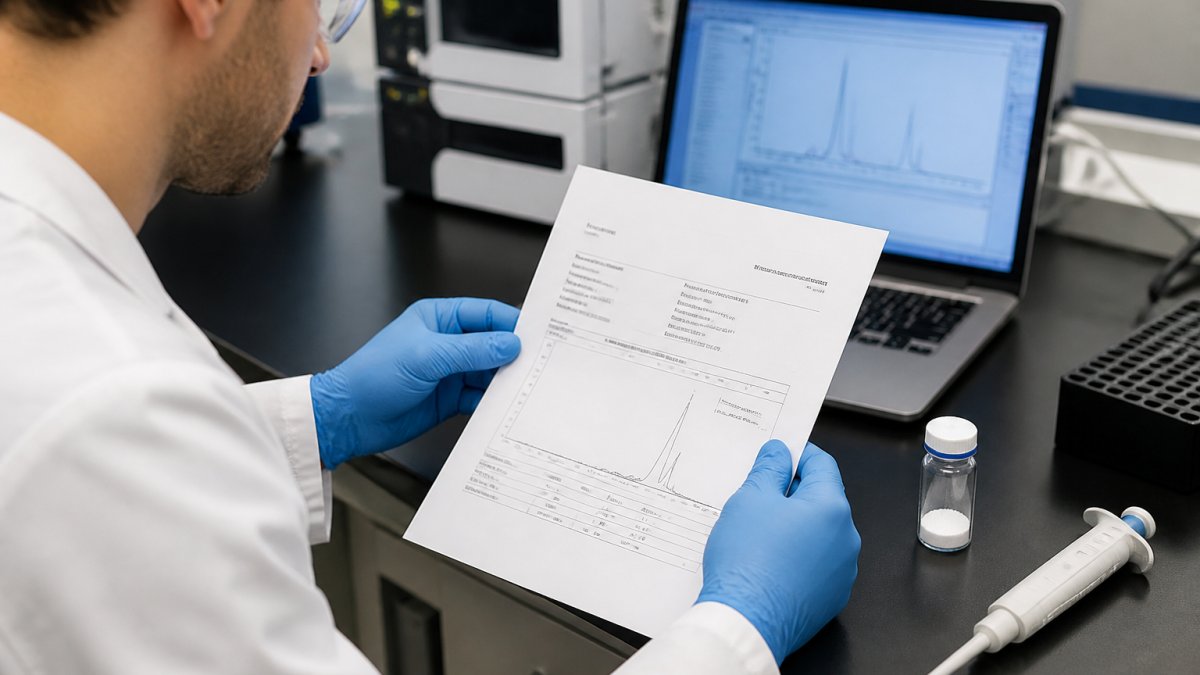
The fastest way to learn how to read COA documents is to walk it top to bottom, field by field.
Block 1, Header and Document Control
The top band of the page answers “what is this document, and can I trace it?”
- Report title: Should read “Certificate of Analysis” (not “Spec Sheet” or “Product Data Sheet”, those are different documents with different legal weight).
- Report number / certificate number: A unique ID for this report. Write it down; you’ll need it if you contact the lab directly.
- Report issue date: When the document was released. Distinct from the test date and the sample-received date.
Block 2, Product and Sample Identification
This block ties the document to a physical vial.
- Product name: Should match your order line exactly, including any salt form (acetate, trifluoroacetate, hydrochloride) and counter-ion notation.
- Catalog number / SKU: The supplier’s internal identifier. Cross-check against your invoice.
- Lot number / batch number: The single most important field. It must match the vial label character-for-character, including leading zeros and hyphens.
Block 3, Results Summary Table
The at-a-glance grid most readers jump to first. Read it last, after confirming the header and identification blocks.
Typical rows:
| Test | Method | Specification | Result |
|---|---|---|---|
| Appearance | Visual | White powder | Conforms |
| Identity | MS | Matches theoretical mass | Conforms |
| Purity | HPLC | ≥ 98.0% | 98.7% |
| Net content | Gravimetric | 5.0 mg | 5.1 mg |
| Water content | Karl Fischer | ≤ 5.0% | 2.3% |
Two things to check on every row: the specification column (what the supplier promised) and the result column (what the lab measured). A result that meets spec is a pass; a result that misses spec but is still printed on the COA means the batch was released anyway, ask why.
Block 4, Analytical Method Details
The block most readers skip and most auditors read first, it tells you whether the numbers above are reproducible.
For HPLC, look for:
- Column: Dimensions and stationary phase (e.g., C18, 4.6 × 250 mm, 5 µm)
- Mobile phase: Solvent system and gradient program
- Detection wavelength: Typically 214 nm or 220 nm for peptides
For MS, look for:
- Ionization mode: ESI or MALDI
- Mass analyzer type: Single quad, triple quad, TOF, Orbitrap
- Calibration standard used to verify mass accuracy
A COA that reports “Purity: 98.7%” with no method block is a number without a foundation.
Block 5, Chromatogram and Spectra
The visual evidence. You want to see:
- The HPLC chromatogram with a labeled main peak, retention time, and peak-area percentage
- The MS spectrum with the molecular ion labeled and the theoretical mass printed alongside the observed mass
- Axis labels and units on both
If the COA shows only a table of numbers and no chromatogram or spectrum, it’s a summary, not a full report.
Block 6, Authorization
At the bottom you should find:
- Analyst name or initials
- Approver / laboratory director signature or e-signature
- Date of approval
An unsigned COA is a draft, not a certificate.
A Five-Minute Review Checklist
Run this in order every time a COA arrives:
- Report number present and unique
- Product name and catalog number match your order
- Lot number matches your vial label exactly
- Sample receipt date is consistent with the batch timeline
- Specification column exists for every result
- Result column meets or exceeds spec
- HPLC method block is complete (column, mobile phase, wavelength)
- Chromatogram is present and the main peak matches the stated purity
- MS observed mass is within tolerance of theoretical mass
- Report is signed and dated
If any item fails, contact the supplier before using the material.
Photograph or scan the COA the day your shipment arrives and store it with the vial’s lot number in the filename. When you revisit an experiment months later, the report number and lot number are the two fields you’ll need, and they’re the two most often lost.
Red Flags and What a COA Cannot Establish
A COA is evidence, not proof. Knowing where it stops being useful matters as much as knowing how to read it.
Documentation Red Flags
Watch for these patterns. None proves wrongdoing alone; each is a reason to ask a question.
- Missing accreditation detail: “ISO/IEC 17025 certified” with no accreditation body, certificate number, or scope statement.
- Numbers without chromatograms: A purity percentage with no accompanying HPLC trace.
- Purity without method: “98.5% pure” with no column, mobile phase, or detection wavelength listed.
If you suspect a report has been altered, do not accuse the supplier publicly. Contact the named laboratory directly with the report number and ask them to confirm the document. Labs keep records and can usually confirm or deny a report within a business day. If the lab has no record of the report number, that is your answer.
Independent Verification Workflow
You don’t have to take a COA at face value. A practical sequence:
- Locate the laboratory’s contact information from the lab’s own website, not from the COA itself. A fraudulent report can print a fake email or phone number.
- Email the lab with the report number, product name, lot number, and test date. Ask them to confirm the report exists and matches the document you hold.
- Ask about accreditation scope. Accreditation is granted for specific tests, not for a lab as a whole. A lab may be accredited for HPLC but not for the specific MS method on your report.
- If a QR code is present, scan it and check that the destination domain matches the lab’s official domain.
- If the report number cannot be verified, request a reissued report directly from the lab. If the lab will not or cannot reissue, treat the COA as unverified.
- Document your verification, date, contact name, and response, alongside the COA in your records.
Most legitimate labs will confirm a report number for a customer or downstream user. A lab that refuses is itself a red flag.
What HPLC and MS Can and Cannot Show
These two methods are powerful and narrow. Understanding their limits prevents overreading a clean report.
HPLC can show:
- Relative abundance of the main peak versus other UV-absorbing species
- Retention time consistency with a reference standard
- Presence of closely related impurities (deletion sequences, truncated fragments) that elute near the main peak
HPLC cannot show:
- Compounds that don’t absorb at the detection wavelength (e.g., many salts, some counter-ions)
- Co-eluting impurities that share a retention time with the main peak
- Absolute mass, only relative peak area
MS can show:
- Molecular mass of the intact molecule, within the instrument’s mass accuracy
- Presence of mass variants that differ from the expected value
MS cannot show:
- Purity. A sample that is 60% target peptide and 40% of a same-mass isomer can produce a clean MS spectrum.
- Sequence. Mass alone does not confirm the order of amino acids, two peptides with the same composition can share a mass.
- Stereochemistry. D- versus L-amino acid substitutions are invisible to a standard mass measurement.
Measurement uncertainty applies to every number on the page. A purity of “98.5%” is a point estimate; the true value sits within a range set by the method’s precision.
Reference standards matter. A purity figure is only as good as the standard it was compared against.
Tests a Purity-Focused COA Usually Omits
A COA built around HPLC purity and MS identity answers two questions, not the many others that matter for research use. Tests commonly absent:
- Residual solvents: Organic solvents left over from synthesis or purification (e.g., acetonitrile, trifluoroacetic acid, dimethylformamide). Relevant when trace solvent exposure affects your assay.
- Water content: Measured by Karl Fischer titration. High water content shifts the effective mass of your peptide and can affect reconstitution.
- Counter-ion content: The acetate, trifluoroacetate, or chloride content that accompanies the peptide. This affects net peptide mass and pH in solution.
If your work requires any of these, ask the supplier for a COA that includes them, or commission the tests yourself through an accredited lab.
What a COA Cannot Establish
Even a complete, verified, third-party COA has boundaries. It confirms identity and purity at the moment of testing. It does not establish:
- Stability over time. A 98% pure peptide can degrade with improper storage. The COA describes the sample on the day it was tested, not the vial in your freezer today.
- Suitability for your specific assay. A peptide can be 99% pure and still fail in a functional assay.
- Absence of undetected contaminants. Every method has a detection limit. Trace contaminants below that limit will not appear.
A COA is a starting point for due diligence, not the end of it. Verify the report with the lab, understand what the methods can and cannot detect, and check whether the panel covers the tests your work actually requires. When the stakes are high, run your own confirmation on the material in hand.
ISO/IEC 17025 standard requirements for testing laboratories | FDA guidance on analytical method validation | NIST resources on mass spectrometry standards
Frequently Asked Questions
What is a certificate of analysis (COA) for a peptide?
A certificate of analysis is a detailed test report that documents the results of third-party laboratory testing performed on a peptide batch. It confirms the product’s identity, purity percentage, and molecular weight, and includes data from analytical methods such as HPLC and mass spectrometry. For research-grade peptides, the COA serves as proof that the compound meets specifications and has undergone independent verification. This documentation is essential for ensuring your research results are reproducible and based on verified materials.
How can I verify that a peptide’s identity matches the COA?
Verify identity by cross-referencing the product name, lot number, and batch number on the COA with the label on your peptide vial. Check that the molecular weight reported in the mass spectrometry results aligns with the expected molecular weight for that peptide sequence. Confirm the testing laboratory is ISO/IEC 17025 certified and independent from the manufacturer. Review the retention time and peak area from the HPLC chromatogram to ensure the compound elutes at the expected position, which is characteristic of that specific peptide’s molecular structure.
What does HPLC results explained mean, and what should I look for?
HPLC (high-performance liquid chromatography) separates peptide components by passing the sample through a column. The results show a chromatogram with peaks representing different compounds. Look for a single dominant peak at the expected retention time, which indicates high purity. The peak area percentage should match the reported purity percentage. Multiple peaks or peaks at unexpected retention times suggest impurities or degradation. The analytical method section should specify the column type, solvent system, and detection wavelength, allowing you to understand the testing conditions and reproduce results in your own research.
What are the limitations of a COA, and what cannot it establish?
A COA confirms purity and identity at the moment of testing but cannot guarantee stability over time or conditions during storage and shipping. It does not detect all possible contaminants unless a broader testing panel was performed. Mass spectrometry confirms molecular weight but does not assess biological activity or confirm that the peptide will perform as expected in your specific research application. A COA also cannot verify that the batch you receive matches the tested sample if documentation controls or chain-of-custody procedures are inadequate. Always verify lot-specific information and request independent testing if your research depends on critical performance parameters.


