
Table of Contents
- Typical Turnaround Times for Peptide Purity Testing
- What Factors Affect Testing Duration
- How HPLC Analysis Works in Peptide Testing
- How to Interpret HPLC and Mass Spectrometry Data
- Understanding Your Peptide Certificate of Analysis
- Peptide Purity Testing Cost and Timeline Correlation
- When to Retest Peptide Batches and Next Steps
- Conclusion
- Frequently Asked Questions
Last Updated: September 27, 2026
Typical Turnaround Times for Peptide Purity Testing
Most peptide purity testing takes between 5 to 10 business days from the moment your sample arrives at the laboratory. This timeframe covers the entire analytical process: sample intake, preparation, HPLC analysis, mass spectrometry confirmation, data review, and Certificate of Analysis generation. (Source: ISO/IEC 17025 certification)
The exact timeline depends on several factors. Rush services can compress this to 2-3 business days, though they typically cost more. Standard processing follows the 5-10 day window. Some labs offer economy options that extend to 15 business days if you’re not in a hurry.
At Minuteman Peptides, we work with ISO/IEC 17025 certified third-party laboratories to ensure your peptide purity testing meets the highest standards. Our transparent reporting means you get detailed results, not just a pass-or-fail verdict. Understanding what drives these timelines helps you plan your research schedule more effectively.
Book your testing early in the week. Samples submitted Monday through Wednesday typically process faster than those arriving Friday, since labs batch work by submission date.
What Factors Affect Testing Duration
The speed of peptide purity testing hinges on five main variables: sample complexity, laboratory queue depth, analytical method required, sample preparation needs, and whether you request rush processing.
Sample Complexity matters most. A simple peptide with few potential impurities runs faster than a complex multi-chain compound. The lab must design detection parameters specific to your molecule. More structural complexity means more method development time upfront.
Laboratory Queue directly impacts your wait. High-volume periods (end of quarter, grant deadline seasons) can push standard turnaround from 7 days to 10 days. Slower periods might deliver results in 5 days. Call ahead to ask about current backlog.
Analytical Method Selection affects duration. HPLC alone is fastest. Adding mass spectrometry confirmation adds 2-3 days. If your peptide requires both reversed-phase chromatography AND mass spec validation, expect the full 10-day window. Specialized methods like UPLC (ultra-performance liquid chromatography) can reduce time by a day or two but cost more.
Sample Preparation can be the hidden bottleneck. If your peptide arrives in a form that requires extensive reconstitution, aliquoting, or solvent adjustment, the lab spends extra time on prep. Peptides that arrive ready-to-analyze move through faster. Proper storage conditions during shipping matter here, degraded samples may need reprocessing.
Rush Services compress timelines but not infinitely. You can’t rush the actual chemistry. A 2-day rush still requires the same analytical work; the lab simply prioritizes your sample and runs it first. This costs significantly more because the lab dedicates dedicated instrument time to your work.
Submitting a sample on Friday and expecting Monday results won’t work. Most labs don’t process samples over weekends. A Friday submission typically enters the queue Monday morning, pushing your earliest results to mid-week at best.
How HPLC Analysis Works in Peptide Testing
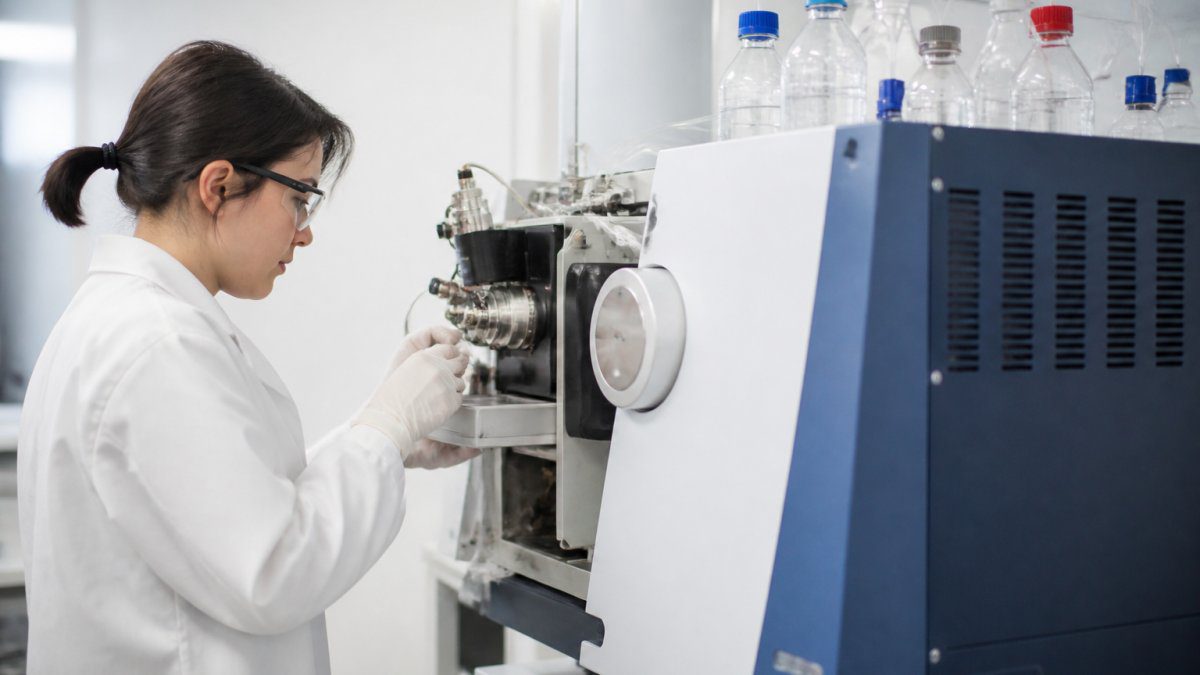
HPLC (high-performance liquid chromatography) separates your peptide from impurities by pushing the sample through a column packed with tiny particles. Different compounds stick to the column for different lengths of time. The detector measures how much light each compound absorbs as it exits the column, creating a chromatogram, a graph showing peaks for each component.
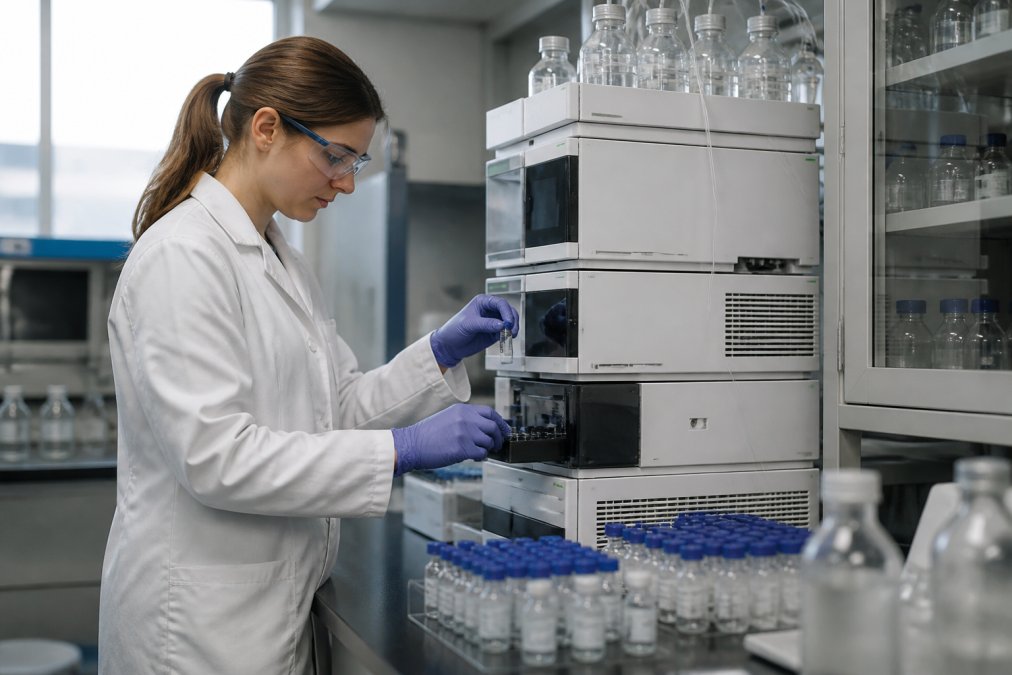
The process takes roughly 15-30 minutes per sample run. But that’s just the instrument time. Before running, technicians must prepare your sample: dissolving it in the right solvent, filtering it, and loading it into the autosampler. This prep adds another 30-60 minutes per batch of samples.
Here’s what happens step-by-step:
- Sample loading: Your peptide vial goes into the autosampler carousel
- Injection: A tiny volume (typically 5-20 microliters) is injected onto the column
- Separation: The liquid mobile phase carries your peptide through the column
- Detection: A UV detector (usually set at 214 nm or 220 nm) measures peptide absorption
- Data collection: The chromatogram records peaks in real time
- Peak integration: Software calculates the area under each peak to determine purity percentage
The 214 nm and 220 nm wavelengths matter because peptides absorb UV light at these frequencies due to their peptide bonds. This wavelength choice is standardized across the industry, it’s not arbitrary.
Most labs run multiple samples in sequence on the same day. If your sample is one of five in a batch, you’re waiting for the four ahead of you. If it’s the only sample, you still wait for method validation and instrument calibration, which the lab does before every run to ensure accuracy.
The actual HPLC run is quick. The bottleneck is sample preparation, instrument setup, and data review, not the chromatography itself.
How to Interpret HPLC and Mass Spectrometry Data
Your HPLC results show purity as a percentage. This number represents the area under your peptide’s main peak divided by the total area of all peaks. A result of 98% means 98% of the sample is your target peptide; the remaining 2% is impurities, residual solvents, or byproducts.
The chromatogram itself tells you more than the number.
When reading the data together:
- HPLC purity percentage tells you how much of your sample is your peptide
- HPLC retention time tells you when your peptide elutes
- Mass spectrometry peak confirms the molecular weight matches your expected peptide
- Multiple MS peaks suggest your peptide may have different ionization states or post-translational modifications
Understanding Your Peptide Certificate of Analysis
Your Certificate of Analysis (COA) is the formal document proving your peptide’s purity and identity. A proper COA includes several key sections: the HPLC chromatogram image, the purity percentage, the mass spectrometry data, the test date, the analytical method used, and the laboratory’s accreditation information.
A thorough COA from a reputable lab includes:
- Sample identification: Your order number, peptide name, and batch number
- HPLC results: The chromatogram image plus calculated purity percentage
- Mass spectrometry data: The observed molecular weight and expected molecular weight
- Retention time: When your peptide elutes on the column
- Testing methodology: Which HPLC method and MS technique were used
- Laboratory accreditation: ISO/IEC 17025 certification number and accreditation scope
- Analyst signature and date: Who performed the test and when
- Quality control notes: Any deviations or special handling
When you receive a COA, check these red flags:
- Missing chromatogram image (you should see the actual peaks)
- No molecular weight data or MS confirmation
- Generic purity percentage with no supporting data
- Vague methodology (“standard HPLC” instead of specific method)
- No laboratory accreditation visible
- Illegible or unsigned document
Researchers who need documented proof of purity for regulatory submissions, grant reports, or publication supplementary materials.
Peptide Purity Testing Cost and Timeline Correlation
Testing cost and turnaround time are directly linked. Faster service costs more because the lab dedicates resources to your sample. Understanding this relationship helps you choose the right service tier for your timeline and budget.
The cost structure also depends on what you’re testing:
- Simple peptides (fewer than 20 amino acids, no modifications) cost less and run faster
- Complex peptides (longer chains, post-translational modifications, multiple forms) cost more and require longer analysis
- Batch testing (multiple samples from the same synthesis) may offer per-sample discounts
- Additional analyses (amino acid composition, endotoxin testing, sterility) add time and cost
Choosing the cheapest option often means accepting the longest wait. If you’re on a grant deadline or preparing for publication, that 30-day economy service becomes a liability, not a savings.
When to Retest Peptide Batches and Next Steps
You should retest a peptide batch in several scenarios: if initial results show purity below your research requirements, if the peptide has been stored longer than recommended, if you suspect degradation, or if you’re using the same batch across multiple experiments spanning months.
After receiving retest results, you have three paths forward:
- Use the batch as-is if purity is acceptable for your research
- Request a replacement batch from your supplier if purity is unacceptable
- Document the purity level in your research methods so readers know exactly what you used
Conclusion
Peptide purity testing typically takes 5-10 business days, but the exact timeline depends on sample complexity, laboratory queue depth, and whether you choose standard or rush processing. Understanding HPLC analysis, mass spectrometry confirmation, and how to read your Certificate of Analysis puts you in control of your research quality. When you partner with Minuteman Peptides, you get cGMP-certified US-based manufacturing combined with independent ISO/IEC 17025 certified third-party testing, ensuring your research compounds meet the highest purity standards with transparent, detailed analytical data.
Frequently Asked Questions
What is a good purity level for research peptides?
Most research applications require peptide purity of 95% or higher, with 98%+ purity preferred for sensitive studies involving growth signaling pathways or metabolic research. The appropriate purity level depends on your specific experimental design and the downstream applications. Higher purity reduces variability and improves reproducibility across multiple batches. Your HPLC and mass spectrometry results will show the exact purity percentage, allowing you to confirm the peptide meets your research requirements before proceeding with experiments.
How do I know if an ISO/IEC 17025 certification is legitimate?
ISO/IEC 17025 certification is issued by accreditation bodies recognized by the American Association for Laboratory Accreditation (A2LA) and similar organizations. Verify a lab’s certification directly through A2LA’s online database or the lab’s official documentation. Legitimate certifications include specific scope statements detailing which analytical methods (HPLC, mass spectrometry, etc.) the lab is accredited to perform. Request the lab’s current certificate and accreditation number, and confirm the certification covers peptide purity testing specifically, not just general analytical services.
Can HPLC and mass spectrometry results be trusted if tested only once?
A single test provides a snapshot of that batch’s composition at the time of analysis. For critical research requiring high confidence in batch-to-batch consistency, requesting testing on multiple aliquots from the same batch or retesting after storage can confirm stability. Reputable suppliers conduct quality assurance testing on every batch and maintain detailed records. When selecting a peptide supplier, ask about their QC protocols and whether they perform replicate testing. This transparency helps ensure your experimental results depend on verified, consistent peptide quality rather than a single data point.
What should I do if a peptide batch fails purity testing?
If a batch does not meet your purity specifications, contact your supplier immediately with the Certificate of Analysis showing the results. Discuss replacement options, refund policies, and turnaround times for a new batch. Some suppliers offer rush testing or expedited manufacturing for replacement batches. Document the failure and store the failed batch appropriately pending resolution. For future orders, establish clear purity requirements upfront and confirm your supplier’s policy on failed batches before committing to a long-term supply relationship for your research.


