
Table of Contents
- Setting Up Your Peptide Storage Workflow
- What You’ll Need Before You Start
- Step 1: Verify Vial Integrity and Purity Documentation
- Step 2: Lyophilized Peptide Storage Temperature and Environmental Controls
- Step 3: Reconstitution and Aliquoting Best Practices
- Step 4: Reconstituted Peptide Shelf Life and Freeze-Thaw Mitigation
- Step 5: Ensuring Peptide Batch Consistency for Research
- Common Mistakes That Compromise Peptide Integrity
- Conclusion
- Frequently Asked Questions
Last Updated: September 24, 2026
Setting Up Your Peptide Storage Workflow
Peptide storage is the set of handling, temperature, and containment practices that keep a research compound stable from arrival to assay. Get it wrong, and your peptide storage lab work falls apart quietly: the vial looks fine, the mass is wrong, and months of data become unusable. This guide from Minuteman Peptides walks through the full workflow, from vial intake to long-term archival, so you can build a storage system that protects batch consistency.
Here’s the short version of what we cover:
- How to check vial integrity and purity paperwork on arrival
- Lyophilized storage temperature and environmental controls
- Reconstitution, buffer choice, and aliquoting
- Reconstituted shelf life and freeze-thaw control
- Batch consistency and emergency protocols
What You’ll Need Before You Start
Before the first vial goes into the freezer, gather your equipment and paperwork. Missing items cause delays that expose peptides to room temperature.
- A calibrated -20°C freezer for routine lyophilized storage
- A -80°C freezer for reconstituted aliquots and long-term archival
- Sterile cryovials in 0.5 mL to 2 mL sizes
- Bacteriostatic water or sterile filtration setup for reconstitution
- Desiccant packs and an inert gas line (nitrogen gas) for oxygen-sensitive sequences
- Light-protected boxes (amber or foil-wrapped)
- A temperature logger with alarm capability
- A labeling system with lot number, date, and concentration fields
Label every aliquot before you reconstitute anything. Writing labels after the fact means vials sit open at room temperature while you work, and that open-air time is one of the most common causes of avoidable degradation.
Step 1: Verify Vial Integrity and Purity Documentation
The first step is a five-minute physical and documentary check per shipment: confirm the vial is intact, the septum unbroken, and the powder or cake as expected, then match the lot number to its certificate of analysis.
Check these items on every COA:
- Purity by HPLC analysis (a single main peak, not a smear)
- Identity confirmed by mass spectrometry
- Lot number matching the vial in your hand
- Testing lab name and accreditation reference
- Date of analysis
Step 2: Lyophilized Peptide Storage Temperature and Environmental Controls
Lyophilized peptide storage temperature is the single biggest lever on long-term stability, but the right setpoint depends on the sequence. Most lyophilized sequences hold well at -20°C for routine work, while -80°C is safer for long archival windows or fragile sequences. Desiccated powder is far more stable than reconstituted liquid, so keep peptides lyophilized until you run assays.
Temperature by Peptide Class
Generic “store at -20°C” advice breaks down with difficult sequences. The table below reflects patterns practitioners report across common research peptide classes; treat it as a starting framework, not a substitute for your own stability checks.
| Peptide Class | Typical Behavior | Recommended Setpoint | Notes |
|---|---|---|---|
| Small hydrophilic (e.g., short linear sequences, many signaling peptides) | Generally robust as lyophilized powder | -20°C | Stable for long archival windows if kept dry |
| Hydrophobic / lipophilic | Prone to aggregation on reconstitution; powder is stable | -20°C to -80°C | Use organic co-solvent at reconstitution; avoid repeated warming |
| Cysteine-containing / disulfide-bonded | Oxidation-sensitive; free thiols can scramble | -80°C | Backfill with inert gas; consider reducing-agent handling |
| Methionine- or tryptophan-containing | Susceptible to oxidation at Met and Trp residues | -80°C | Nitrogen headspace is strongly advised |
| Long or highly charged sequences | Higher aggregation risk; slower to dissolve | -80°C | Aliquot small; avoid high-concentration stocks |
| Modified / conjugated peptides (PEGylated, fluorescently labeled) | Label or linker can be the weak point | -80°C | Protect from light; verify label stability separately |
Light, Moisture, and Oxygen Protection
Three environmental threats do most of the damage: light, moisture, and oxygen.
- Light: store in amber vials or foil-wrapped boxes. UV exposure drives oxidation, and it hits tryptophan and tyrosine residues first. Fluorescently labeled peptides are especially vulnerable because the fluorophore itself can photobleach.
- Moisture: add desiccant to each storage box and let vials reach room temperature before opening. Condensation on a cold vial is a real risk, and moisture accelerates both hydrolysis and aggregation.
- Oxygen: for oxidation-prone sequences, backfill the headspace with nitrogen gas to create an inert atmosphere. This matters most for methionine- and cysteine-containing peptides.
Never open a vial straight from the freezer. Condensation forms on the cold glass and pulls moisture into the powder. Let vials equilibrate to room temperature inside a sealed bag first, or you risk caking and aggregation, a failure mode that is irreversible once the cake collapses.
Match the setpoint to the sequence, not to habit. Hydrophilic and robust sequences tolerate -20°C; oxidation-prone, disulfide-bonded, and aggregation-prone sequences belong at -80°C with an inert headspace.
Step 3: Reconstitution and Aliquoting Best Practices
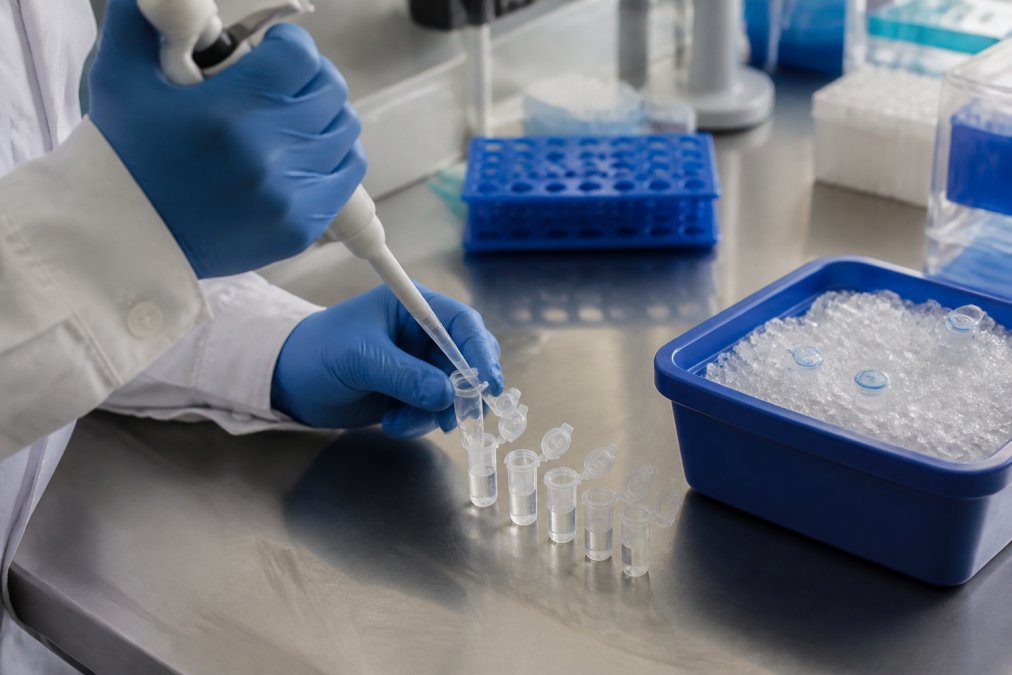
Reconstitution and aliquoting decide how much usable peptide you get. Dissolve the powder in the right solvent at the right concentration, then split it into single-use aliquots before anything goes back in the freezer.
Buffer Selection and Solubility Considerations
Buffer compatibility drives solubility and stability. Match buffer pH to the peptide’s isoelectric point, and avoid buffers that react with your sequence.
- Phosphate-buffered saline: a solid default for many sequences
- Acetate or citrate buffers: useful when you need a lower pH
- Bacteriostatic water: fine for many reconstitutions, but check compatibility first
- Avoid: buffers with free amines if your sequence is sensitive to them
The best aliquot is one you use once and discard. Size every vial to a single experiment, and you remove freeze-thaw damage from your workflow entirely.
Step 4: Reconstituted Peptide Shelf Life and Freeze-Thaw Mitigation
Reconstituted peptide shelf life is short, often days to weeks refrigerated and months at -80°C, depending on sequence and buffer. Treat every reconstituted vial as perishable and plan its use accordingly.
- Aliquot before the first freeze
- Store aliquots at -80°C, not -20°C
- Keep working stocks at 4°C for short-term use only
- Never refreeze a thawed aliquot
- Log every freeze-thaw event on the vial label
Step 5: Ensuring Peptide Batch Consistency for Research
Peptide batch consistency for research depends on treating storage as a controlled process, not a habit. Consistent results across an 18-month study come from consistent handling, not luck.
Build a simple system:
- One storage SOP, version-controlled and posted at the freezer
- A log for every vial: lot, date received, date opened, storage location
- A temperature log with alarm thresholds
- Periodic purity verification by HPLC analysis on retained samples
- Retained reference aliquots from each lot for side-by-side comparison
| Log Field | What to Record | Why It Matters |
|---|---|---|
| Lot number | Supplier lot on the vial and COA | Ties results to a specific batch |
| Receipt date | Day the shipment arrived | Starts the stability clock |
| Storage location | Freezer, rack, box, position | Enables fast retrieval |
| Open date | First time the vial was opened | Tracks exposure events |
| Purity check | Date and result of any re-test | Flags degradation early |
Keep one retained reference aliquot per lot, untouched, at -80°C. When a result looks off, run the reference alongside your working sample. It separates a handling problem from a compound problem in a single experiment.
Common Mistakes That Compromise Peptide Integrity
Most storage failures trace back to a short list of repeatable errors. Fix these and you remove most avoidable variability.
- Storing reconstituted peptide at -20°C. It’s too warm for long-term liquid storage; use -80°C.
- Reusing a thawed aliquot. Every refreeze adds damage.
- Skipping the room-temperature step. Condensation ruins powder.
- Storing in clear vials under light. Oxidation follows, and it hits sensitive residues first.
- Ignoring the COA. You can’t reproduce what you can’t document.
- Mixing lots in one box. Retrieval errors and cross-contamination follow.
- Trusting the freezer display. The readout shows air temperature, not vial temperature, and it can drift from reality by several degrees.
Emergency Storage Protocols
Freezer failures happen, compressor failure, a door left ajar, a power event. A plan turns a disaster into an inconvenience; the critical variables are time out of storage and whether the peptide is still lyophilized.
Emergency protocol, in order:
- Detect. A temperature logger with alarm capability is the only reliable detection method. A freezer with no alarm can fail overnight and you will not know until morning.
- Isolate. Move vials to a backup freezer or dry ice immediately. Lyophilized powder tolerates a short warm period far better than reconstituted liquid; prioritize liquid aliquots first if you cannot move everything at once.
- Document. Record the time out of storage, the peak temperature reached, and the total duration. This record determines whether the affected lots need re-testing.
- Assess. Re-check purity on affected lots before using them in critical assays. Lyophilized powder that stayed cold and dry is usually fine; reconstituted liquid that warmed is suspect.
- Restock. Replace dry ice, test the backup freezer under load, and log the event so the next response is faster.
Validation Protocols for Storage Efficacy
Validation is the part most labs skip, and it separates a documented storage system from a hopeful one. The goal is to prove your conditions are holding, not assume they are.
| Validation Activity | Frequency | What It Confirms |
|---|---|---|
| Control aliquot purity check | Intake, midpoint, end | Storage conditions are holding |
| Mock freezer failure drill | Quarterly | Response plan works |
| Temperature mapping | On setup, then annually | No warm or cold spots |
| Logger calibration check | Annually | Alarm thresholds are accurate |
| Reference aliquot comparison | As needed | Handling vs. compound problem |
Schedule validation on the calendar, not on memory. A control test that only happens when someone remembers is a control test that never happens, and the gap it leaves is exactly where bad data hides.
Conclusion
Storage is where peptide research is won or lost, and the failures are almost always preventable. A documented intake process, the right temperature, protected vials, single-use aliquots, and a tested emergency plan keep your data reproducible for the life of a study.
Frequently Asked Questions
How long can reconstituted peptides be stored before they degrade?
Reconstituted peptide shelf life depends on the sequence, buffer, and storage temperature. Most reconstituted peptides remain stable for one to two weeks at 4°C, but freezing aliquots at -20°C or -80°C extends usable life to several months. Store aliquots in sterile, light-protected vials and avoid repeated freeze-thaw cycles. Always check your Certificate of Analysis for sequence-specific stability guidance.
What temperature should lyophilized peptides be stored at?
Lyophilized peptide storage temperature recommendations vary by sequence, but most desiccated peptides remain stable for months to years at -20°C. Some hydrophobic or oxidation-prone sequences require -80°C. Store vials in a desiccator with desiccant to prevent moisture uptake, keep them light-protected, and allow vials to reach room temperature before opening to avoid condensation.
What environmental factors destroy peptide integrity?
Moisture, oxygen, light, and temperature fluctuation are the primary threats. Repeated freeze-thaw cycles cause aggregation and denaturation. Microbial growth can occur in reconstituted solutions without sterile filtration or bacteriostatic water. Always use aseptic technique, store in light-protected cryovials, and minimize air exposure. An inert atmosphere of nitrogen gas can help prevent oxidation for sensitive sequences.
How do I ensure peptide batch consistency for research?
Request a Certificate of Analysis for every batch showing HPLC analysis and mass spectrometry results. Verify purity levels and confirm the molecular weight matches your expected sequence. Aliquot a reference sample from each batch for side-by-side comparison. Follow identical reconstitution and storage protocols across batches. Peptide batch consistency for research depends on both supplier quality control and your own handling procedures.