
Table of Contents
- Why Independent ISO 17025 Verification Matters for Research Integrity
- How to Check If a Laboratory Is ISO 17025 Accredited
- ISO 17025 Accreditation Scope Verification: Matching Tests to Claims
- Understanding Certificate of Analysis (COA) Components
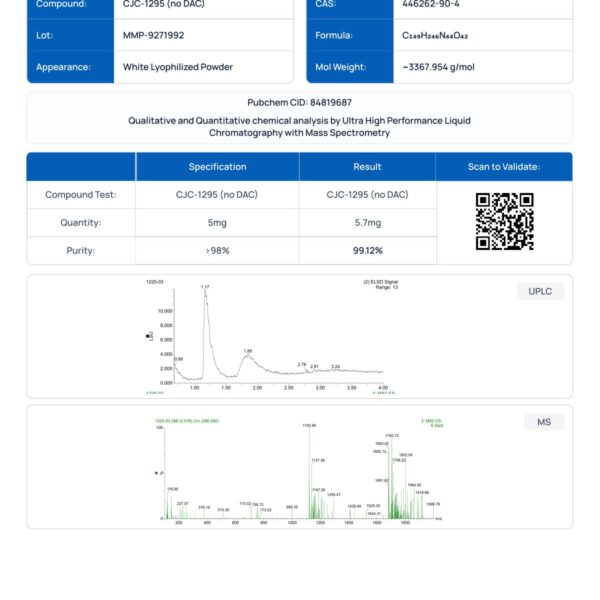
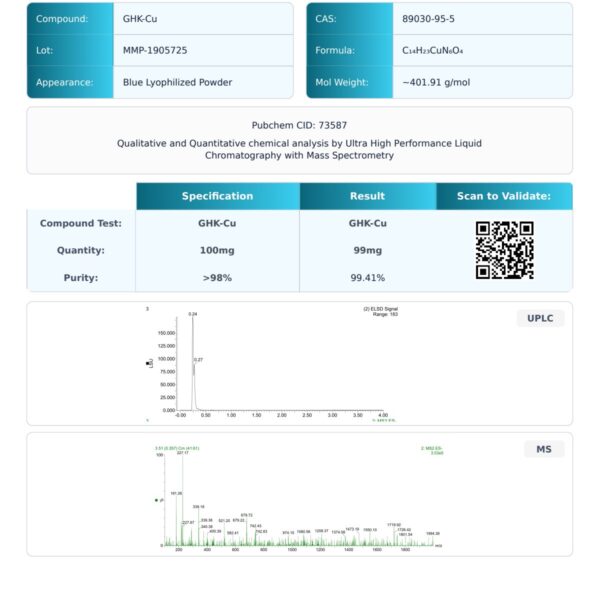
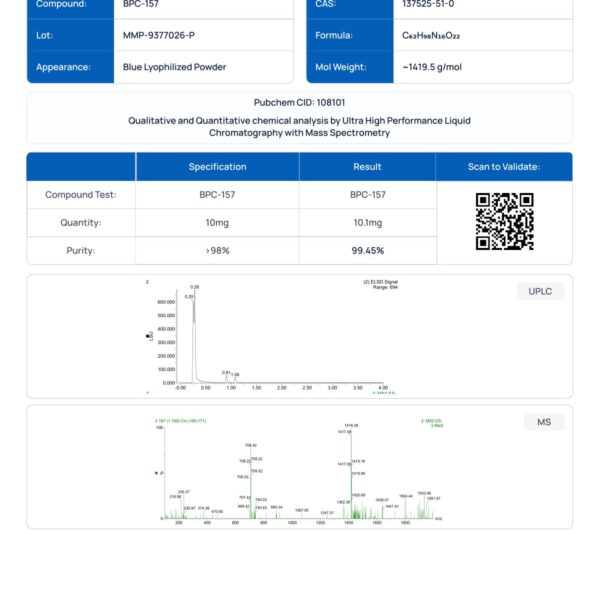
- How to Interpret HPLC Mass Spectrometry Data in a Test Report
- Spotting Fraudulent Certificates: Red Flags for Non-Technical Buyers
- Frequently Asked Questions
Last Updated: September 10, 2026
Why Independent ISO 17025 Verification Matters for Research Integrity
A certificate of analysis is only as trustworthy as the laboratory that issued it, which is why verifying independent ISO 17025 laboratory results matters so much. When a supplier claims third-party testing, verifying independent ISO 17025 laboratory results is the step that separates reproducible science from unverifiable marketing.
Minuteman Peptides operates on a simple premise: research compounds should arrive with documentation a principal investigator can actually audit. Every batch we ship undergoes independent ISO/IEC 17025 certified third-party testing, with HPLC and mass spectrometry data published in a transparent certificate of analysis (iso.org). That standard exists because the alternative, trusting a supplier’s unverified purity claim, has quietly derailed countless experiments.
The stakes are concrete. Impure or misidentified compounds produce analytical results that cannot be replicated, and a failed replication wastes months of a postdoctoral fellow’s time. According to ISO/IEC 17025 general requirements for testing laboratories, accreditation confirms that a laboratory operates a documented quality management system and demonstrates technical competence for specific test methods, not merely that it owns the right instruments.
Below, we’ll show you exactly how to verify a lab’s accreditation, read its scope, and spot the red flags that indicate a fabricated certificate. The process takes about fifteen minutes per supplier, and it will save you from the most expensive mistake in research procurement: trusting a document nobody checked.
How to Check If a Laboratory Is ISO 17025 Accredited
Verifying a laboratory’s accreditation means confirming three separate things: that an accreditation body exists and is recognized, that the lab appears in that body’s public directory, and that the specific test you need falls within the lab’s accredited scope. A logo on a certificate proves none of these on its own.

Step 1: Identify the Accreditation Body
Start by finding the name of the organization that issued the accreditation. It will appear on the test report or certificate, usually near the laboratory’s name and accreditation number.
A legitimate accreditation body is itself recognized under a mutual recognition arrangement, most commonly the ILAC-MRA. Look up the body through the ILAC mutual recognition arrangement signatory list. If the issuing organization does not appear there, treat the accreditation as unverified.
Step 2: Search the Public Accreditation Directory
Next, go to the accreditation body’s own public directory and search the laboratory’s legal name or accreditation number. What most buyers miss is that directories list the lab’s legal entity, which often differs from its trading name. If the search returns nothing, ask the supplier for the exact legal name under which the lab was accredited.
Confirm that the directory entry is current. Lapsed, suspended, or withdrawn accreditations frequently remain printed on certificates for months after they expire.
ISO 17025 Accreditation Scope Verification: Matching Tests to Claims
Scope verification is where most procurement teams stop short, and it is where the real risk lives. An accredited laboratory is accredited for specific test methods, not for everything it offers. A lab may hold accreditation for high-performance liquid chromatography while its mass spectrometry work sits outside the accredited scope. A certificate that reports both results without distinguishing between them is technically misleading, even if every number on it is accurate.
What a Scope Entry Actually Looks Like
A scope document is not a list of services. It is a table of accredited methods, and each row typically contains four fields you need to read together:
- Method designation, the standard or in-house method number, such as an ASTM, USP, or EPA method, or a lab-specific SOP identifier
- Analyte or parameter, what the method measures, such as identity by mass spectrometry or purity by HPLC
- Matrix, the material type the accreditation covers, such as a pharmaceutical preparation, a reference standard, or a research chemical
- Technique or instrument class, the platform the method runs on, such as LC-MS/MS or GC-MS
A scope entry that reads “Purity determination by HPLC” does not automatically cover “Identity confirmation by LC-MS.” Those are separate rows, and a lab can hold one without the other.
A Worked Example: Matching a COA Line to a Scope Row
Suppose your certificate of analysis reports two results: 98.7% purity by HPLC and a confirmed molecular ion by mass spectrometry. Here is how to match each line to the scope:
- Pull the scope document from the accreditation body’s public directory, not from the supplier’s website. The directory version is the authoritative one.
- Find the HPLC purity row. Confirm the method designation on the scope matches the designation printed on the COA. A common failure point is a COA that cites an internal method number while the scope lists a different, accredited method.
- Find the mass spectrometry row separately. Do not assume that because the lab is accredited for HPLC, it is also accredited for MS. Check for a distinct row covering the MS technique and the identity parameter.
- Check the matrix. If the scope row is limited to a matrix that does not match your material, the accreditation does not extend to your sample even though the method name matches.
- Note any COA line with no corresponding scope row. That result may still be scientifically valid, but it carries no accreditation backing.
Resolving a Mismatch
If a COA line does not map to a scope row, you have three options, in order of preference:
- Ask the supplier to provide a COA from a laboratory whose scope explicitly covers that method and matrix.
- Ask the laboratory to confirm in writing whether the test was performed under its accredited scope or outside it.
- Treat the out-of-scope result as supporting information only, not as accredited data.
For research requiring documented traceability, that distinction matters. An accreditation number attached to out-of-scope testing is a compliance gap, not a credential.
A common mistake is accepting a certificate that lists an accreditation number without listing which tests that number covers. The number identifies the laboratory; the scope identifies the methods. You need both.
Scope verification is a row-by-row match, not a logo check. For every result on the COA, find the corresponding scope row and confirm the method designation, parameter, and matrix all line up.
Understanding Certificate of Analysis (COA) Components
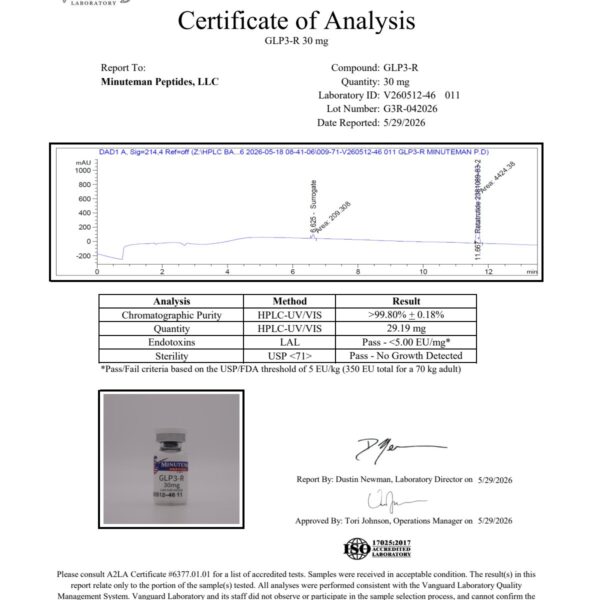
A certificate of analysis is a formal record of the analytical results for a specific batch, and it should let an independent reviewer reconstruct what was tested and how. Vague COAs are a warning sign, not a convenience.
What a Compliant Test Report Must Include
A complete report typically contains several distinct elements. Each one serves a purpose in establishing the validity of results.
| Component | What It Establishes | Red Flag If Missing |
|---|---|---|
| Laboratory name and accreditation number | Identifies the testing party | No lab identified |
| Accreditation body and scope reference | Confirms accredited methods | No body named |
| Batch or lot number | Links results to your material | Generic or absent lot ID |
| Test method and instrument | Shows how the analysis ran | Method not stated |
| Analytical results with units | Reports the actual measurement | Results without units |
| Chromatogram and spectra | Allows independent review | Raw data not provided |
| Authorized signature and date | Confirms report authenticity | Unsigned or undated |
What most guides miss is the batch linkage. A COA that reports excellent purity for a batch number that does not match your vial tells you nothing about your material. Confirm the lot number on the report matches the lot number on the container.
How to Interpret HPLC Mass Spectrometry Data in a Test Report
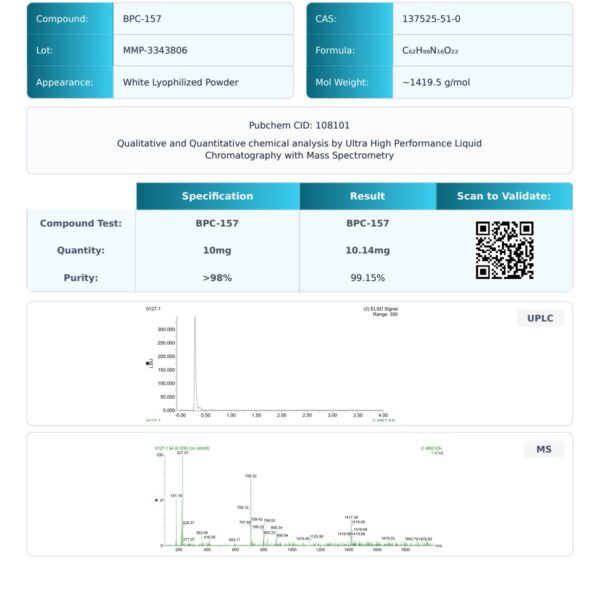
Interpreting HPLC mass spectrometry data means reading two complementary results together: chromatography establishes purity, while mass spectrometry confirms identity. Neither alone is sufficient.
High-performance liquid chromatography (HPLC) separates the components of a sample and reports purity as a percentage based on peak area. A clean chromatogram shows a single dominant peak with minimal secondary peaks. The retention time and peak area are the numbers to check first.
Mass spectrometry (MS) measures the mass-to-charge ratio of the ionized compound, confirming that the molecule present matches the expected structure. The observed mass should align with the theoretical molecular weight within the instrument’s stated measurement uncertainty.
Read the two together. A sample can show high HPLC purity while the MS result reveals the dominant peak is the wrong molecule entirely. That combination, high purity of the wrong compound, is exactly what a single-method COA would hide.
Ask for the full chromatogram and mass spectrum, not just the summary purity figure. A summary percentage is a conclusion; the underlying data is the evidence. Suppliers confident in their testing share both without hesitation.
Spotting Fraudulent Certificates: Red Flags for Non-Technical Buyers
Fraudulent certificates are more common than most procurement teams assume, and they are designed to look credible at a glance. The tells are usually structural rather than scientific, which means a non-technical buyer can catch them without understanding the chemistry. This section is a cheat sheet for purchasing and procurement staff who need to verify a laboratory without a science background.
The Five-Minute Document Inspection
Work through these checks in order. Each one takes under a minute and does not require technical training.
- Find the accreditation number. It should be printed on the report, not just referenced in an email. If there is no number, stop here.
- Search the number in the accreditation body’s public directory. A fabricated number will not resolve to a real laboratory. This single check eliminates most fraudulent certificates.
- Confirm the laboratory name in the directory matches the name on the report. Watch for near-miss names, such as a trading name that resembles an accredited legal entity but is not the same organization.
- Check the directory entry’s status and expiration date. Lapsed, suspended, or withdrawn accreditations frequently remain printed on certificates for months after they expire.
- Confirm the batch or lot number on the report matches the lot number on your container. A COA that reports excellent purity for a different batch tells you nothing about your material.
Document-Level Red Flags
These are the structural signals that a certificate was fabricated or altered rather than issued:
- A scope that claims every test method. Real scopes are specific and often narrow. A certificate implying the lab is accredited for everything is a warning sign.
- Identical data across unrelated batches. Copy-pasted results with matching decimal values across different lot numbers indicate fabrication.
- Missing raw data. A report that summarizes purity but never shows a chromatogram or spectrum cannot be independently reviewed.
- No authorized signature or a generic signatory title. Legitimate reports name the responsible analyst or reviewer.
- A laboratory address that cannot be verified. Cross-check the physical location against the accreditation directory entry.
- Inconsistent formatting or fonts within the document. Altered certificates often show mismatched typefaces, misaligned tables, or a signature block that does not match the rest of the page.
- A scope reference that does not match the directory. If the certificate cites a scope that differs from the one published by the accreditation body, treat the certificate as unverified.
A Non-Technical Decision Rule
If you cannot complete the five-minute inspection, do not accept the result. The practical rule for non-technical buyers is simple: verify the accreditation number in the public directory before you accept any result, and confirm the batch number matches your material. Those two checks alone eliminate most fraudulent certificates, because a fabricated number will not resolve to a real, in-scope laboratory, and a mismatched batch number means the report does not describe your sample.
Keep a one-page checklist with the five inspection steps and the document-level red flags. A procurement team that runs the same checklist on every supplier catches inconsistencies that a one-off review would miss.
At Minuteman Peptides, we publish the underlying HPLC and mass spectrometry data with every batch so that researchers can perform exactly this kind of independent verification rather than taking our word for it. Our compounds are manufactured in cGMP-certified facilities and tested by an independent ISO/IEC 17025 certified laboratory, and the resulting certificates are provided in full.
Frequently Asked Questions
How can I check if a laboratory is currently ISO/IEC 17025 accredited?
Start by identifying the accreditation body listed on the test report or COA. Then search that body’s public accreditation directory for the laboratory’s name and certificate number. Confirm the accreditation status is active, not suspended or withdrawn. Cross-check the scope of accreditation to ensure the specific test methods used for your analysis are covered. The ILAC-MRA mark also allows you to verify accreditation through international mutual recognition arrangements.
What is the difference between ISO 9001 and ISO/IEC 17025 certification?
ISO 9001 addresses general quality management systems across any industry, while ISO/IEC 17025 specifically covers the technical competence of testing and calibration laboratories. A lab with ISO 9001 certification has documented quality processes, but that does not confirm its analytical results are technically valid. ISO/IEC 17025 requires demonstrated proficiency testing, measurement traceability, and validated test methods, making it the relevant standard for verifying laboratory results.
How do I interpret HPLC and mass spectrometry data in a lab report?
Look for the retention time, peak area percentage, and the specific wavelength used in HPLC analysis. For mass spectrometry, check the observed molecular weight against the expected theoretical mass. A purity figure above 95% from HPLC, combined with a mass spec result matching the expected molecular ion, supports the identity and purity claims. Verify that the reported method parameters, including column type and mobile phase, are documented so the analysis can be repeated.
What specific elements should appear on an ISO/IEC 17025 compliant test report?
A compliant test report includes the laboratory’s name and accreditation number, a unique report identifier, the test method used, sample identification, dates of receipt and testing, analytical results with measurement uncertainty where applicable, and the signature of an authorized representative. The report should also state the scope of accreditation and clearly separate accredited from non-accredited results. Missing any of these elements is a reason to question the report’s validity.