

Table of Contents
- Why Peptide Experimental Results Vary
- Peptide Stability and Degradation Factors
- Peptide Batch Consistency for Research
- Common Causes of Peptide Assay Failure
- Peptide Storage Best Practices
- How to Interpret Peptide Certificate of Analysis
- Ensuring Reproducibility in Your Research
- Conclusion
- Frequently Asked Questions
Last Updated: September 23, 2026
Why Peptide Experimental Results Vary
Peptide experimental results vary due to storage conditions, sample handling, reagent quality, and assay methodology. Labs producing inconsistent results typically underestimate peptide sensitivity to environmental stress, skip protocol validation against certified reference materials, or source from suppliers lacking rigorous third-party testing. (Source: ISO/IEC 17025 standards for laboratory competence)
A peptide may degrade silently during storage, transit, or reconstitution. Assay conditions can fail if a single variable shifts, temperature, humidity, or buffer pH. Reproducibility depends on identifying and controlling these variables systematically.
Peptide Stability and Degradation Factors
Peptide stability depends on amino acid sequence, three-dimensional structure, and environment. Proteases and peptidases, which cleave peptide bonds, represent the most significant threat to stability, especially in biological samples or cell culture media.
Temperature is the primary driver of peptide degradation. Room temperature storage accelerates chemical and enzymatic breakdown. Freeze-thaw cycles damage molecular structure and allow proteolytic activity to resume. Humidity and light exposure contribute to oxidation and cross-linking, especially for peptides containing methionine or tryptophan.
Storage buffer pH matters significantly; drift outside optimal range causes peptide bond hydrolysis and chemical modifications. Oxygen exposure drives oxidative degradation; inert atmosphere or nitrogen-flushed vials extend shelf life. Trace metals in buffers can catalyze unwanted reactions.
A peptide batch tested as 98% pure at synthesis may show only 92% purity three months later, explaining assay drift if active material loss isn’t accounted for.
Peptide Batch Consistency for Research
Batch-to-batch variability arises during synthesis, purification, and storage. Even with identical protocols, minor variations in reaction conditions, solvent composition, or purification efficiency produce measurable differences between batches.
Coupling efficiency (percentage of chains successfully incorporating each amino acid) compounds across long sequences. A 99% per-step efficiency in a 20-amino-acid peptide yields only ~82% full-length chains; the remaining 18% are truncated variants removed during purification. Small changes in reagent age, temperature, or reaction time shift this distribution.
Purification methods introduce variability. Reversed-phase HPLC resolution depends on column condition, solvent gradient precision, and buffer ionic strength. Batches purified under slightly different conditions may have different impurity profiles despite identical main peaks.
One batch may contain 1% of a hydrophobic impurity that doesn’t interfere with your assay; another may contain 2.5%, which shifts your readout. Without independent third-party verification using mass spectrometry and HPLC, you won’t detect this variation until assay failure.
Common Causes of Peptide Assay Failure
Common causes of peptide assay failure fall into three categories: sample preparation errors, assay condition drift, and material degradation. Each can independently sabotage reproducibility.
Reconstitution errors top the list. Buffer osmolarity, pH, and surfactants affect dissolution completeness. Incomplete dissolution creates heterogeneous samples. Aggressive vortexing creates foam and air-peptide interfaces where oxidation accelerates. Room temperature storage permits protease activity and degradation.
Assay failures stem from suboptimal digestion or incomplete modification. Assay methods show sensitivity to peptide sequence and structure; a proline-rich peptide may not react identically to a lysine-rich one in a Bradford assay at the same molar concentration. Enzymatic digestion assays fail when incubation time, temperature, or enzyme concentration deviates from protocol.
Endotoxin contamination is a hidden failure mode in peptides from bacterial fermentation-derived precursors or non-sterile purification. Endotoxins trigger innate immune responses in cell-based assays, producing false positives or erratic dose-response curves. Many researchers skip endotoxin testing (LAL or kinetic chromogenic methods) and misattribute assay failure to the peptide.
Temperature excursions during shipping or storage cause assay failures. A peptide sample that performed perfectly may fail if it experienced a temperature spike during transit or freezer thermostat drift, reducing potency or changing aggregation state.
Peptide Storage Best Practices
Inspect vials for damage, discoloration, or leakage upon receipt. Document condition and ambient temperature at arrival. Non-insulated boxes during summer may expose peptides to elevated temperatures despite ice packs.
Store lyophilized peptides at -20°C in a dedicated box, or preferably at -80°C to dramatically slow degradation. Use original amber or opaque containers to minimize light exposure. Replace silica desiccant packs if saturated.
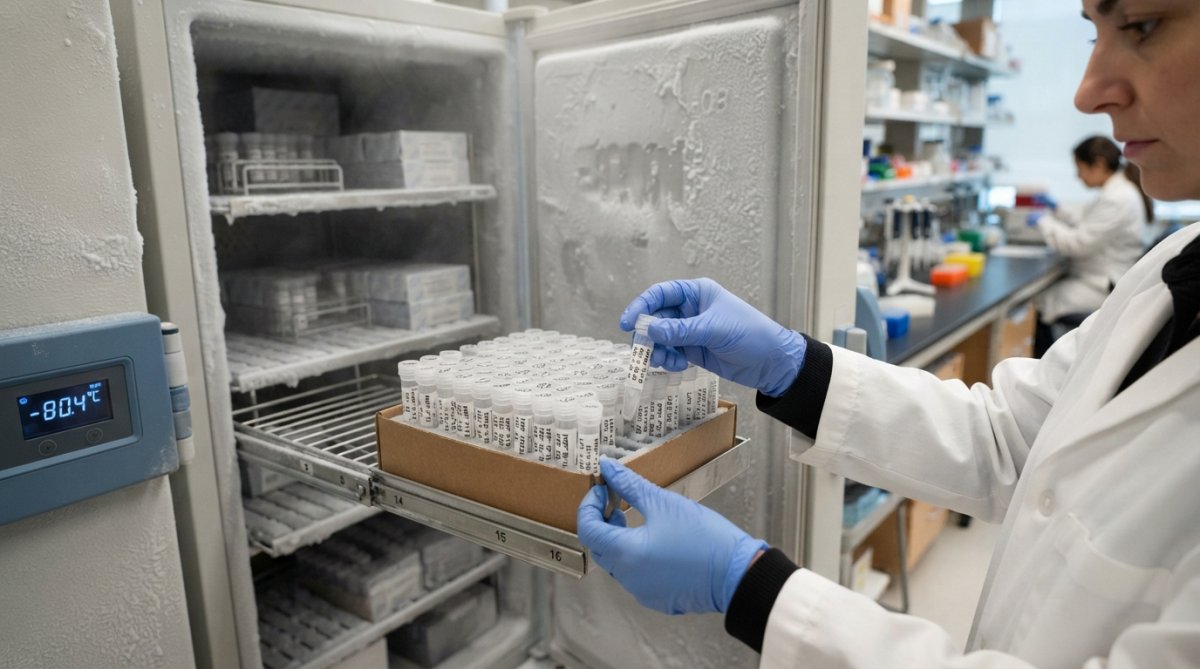
Lyophilized peptides are hygroscopic; minimize open-vial time and replace caps immediately. Store reconstituted peptides at -20°C or -80°C, not at 4°C for extended periods. Many peptides degrade within two weeks at refrigerator temperature due to residual protease activity and oxidation.
Document storage conditions: date received, date opened, storage temperature, and reconstitution details. This metadata helps troubleshoot assay variability and identify whether temperature excursions or extended storage caused batch-to-batch differences.
Avoid repeated freeze-thaw cycles. Aliquot reconstituted peptides into smaller volumes before freezing. Use one aliquot per experiment and discard unused portions rather than refreezing.
How to Interpret Peptide Certificate of Analysis
A Certificate of Analysis (COA) documents what was tested, how, and the results. A COA should include peptide name and sequence, batch number, analysis date, and testing laboratory identity.
A peptide reported as “98% pure by HPLC” means the main peak accounts for 98% of total chromatogram area. The remaining 2% could be truncated variants, oxidized forms, or synthesis byproducts that may interfere with your assay.
Examine the HPLC chromatogram if included. A sample with one small impurity peak at 98% purity is more homogeneous than one with multiple small peaks. Multiple peaks indicate greater chemical diversity and higher risk of unexpected assay behavior.
Mass spectrometry confirms peptide identity and purity. The spectrum should show a primary peak at expected molecular weight with minimal satellite peaks. Significant peaks at M+1, M+2, or unexpected fragments indicate unwanted modification or degradation; request supplier clarification.
Peptide concentration, if reported, should match the expected concentration based on the vial’s labeled weight and the reconstitution volume. If the reported concentration is significantly lower than expected, the peptide may have aggregated, precipitated, or partially degraded before testing.
Check the testing laboratory’s credentials. Independent, third-party testing by an ISO/IEC 17025 certified laboratory carries more weight than in-house testing by the manufacturer. A COA from a certified lab confirms that the testing was performed under rigorous quality assurance standards and that the results are traceable to national standards.
Ensuring Reproducibility in Your Research
Reproducibility in peptide research depends on controlling variables systematically and validating your methods against known standards. Begin by establishing a written protocol for every step: peptide storage, reconstitution, sample preparation, and assay execution. Include specific details, buffer composition, pH, temperature, incubation time, centrifugation speed, so that you or a colleague can repeat the experiment identically months later.
Validate your assay using a reference peptide or a certified standard. Many commercial suppliers offer reference materials with certified purity and potency. Run your assay against this standard first, and document the expected result. Then run your experimental peptide in parallel. If the experimental peptide’s result deviates significantly from the standard, you’ve identified a problem with either the peptide or your assay conditions before you invest time in downstream experiments.
Prepare positive and negative controls for every assay run. A positive control should be a peptide or sample you know behaves as expected; a negative control should be a blank or a peptide that should produce no signal. If your controls fail, your experimental results are uninterpretable.
Track ambient conditions. Record the room temperature, humidity, and any deviations from your standard operating procedure.
Conclusion
Peptide experimental results vary because peptides are chemically unstable, synthetically variable, and exquisitely sensitive to handling and storage conditions. Controlling this variability requires attention to peptide stability, batch consistency, assay methodology, and documentation. When you source peptides from suppliers committed to rigorous quality control, such as Minuteman Peptides, which uses cGMP-certified US manufacturing and independent ISO/IEC 17025 certified third-party testing with verified HPLC and mass spectrometry results, you eliminate a major source of experimental noise.
| Variable | Impact on Results | Control Method |
|---|---|---|
| Storage temperature | Accelerates degradation; freeze-thaw cycles damage structure | Use -80°C freezer; minimize freeze-thaw cycles |
| Reconstitution buffer | Affects solubility and peptide stability | Use validated buffer; document pH and osmolarity |
| Assay incubation time | Incomplete or excessive digestion alters readout | Follow validated protocol; use timer |
| Peptide purity at receipt | Impurities interfere with assay or skew results | Request COA with HPLC and mass spectrometry data |
| Batch-to-batch variability | Different impurity profiles produce different assay behavior | Source from suppliers with rigorous QC; test reference standards |
| Ambient humidity | Lyophilized peptides absorb moisture; reconstituted samples oxidize | Store in desiccant-packed vials; minimize air exposure |
Frequently Asked Questions
What are the main factors that cause peptide experimental results to vary between batches?
Peptide experimental results vary due to several interconnected factors: peptide stability issues during storage, protease activity in your assay buffer, reconstitution errors, and batch-to-batch variability in synthesis or purification. Temperature fluctuations, improper pH, and exposure to light degrade peptides over time, reducing bioavailability and target specificity. Manufacturing differences between batches affect peptide purity and protein concentration. Using cGMP-certified, US-based suppliers with ISO/IEC 17025 certified third-party testing significantly reduces this variability by ensuring consistent synthesis and analytical validation across all batches.
How can I verify that a peptide certificate of analysis actually reflects what I’m receiving?
A legitimate certificate of analysis should include HPLC and Mass Spectrometry results from an independent, ISO/IEC 17025 certified laboratory, not the manufacturer’s internal testing alone. Look for specific data: exact purity percentages, molecular weight confirmation, and endotoxin contamination levels. Cross-reference batch numbers on the COA with your shipment. Request historical data from the supplier showing batch consistency over multiple orders. Reputable suppliers like Minuteman Peptides provide transparent, verified results from US-based certified labs, giving you confidence that analytical validation matches your actual material.
Why is peptide storage critical for maintaining experimental reproducibility?
Peptides degrade through multiple mechanisms during storage: proteolytic degradation from residual proteases, oxidation from oxygen exposure, and hydrolysis from moisture. Temperature fluctuations accelerate degradation kinetics exponentially. Improper storage conditions compromise peptide purity and reduce bioavailability, causing your assay reproducibility to decline over weeks or months. Storing peptides at -20°C or -80°C, in airtight vials, with desiccant packets, and away from light preserves stability for extended periods. Documenting storage conditions and handling protocols helps you identify whether experimental variance stems from peptide degradation or your assay methodology, enabling faster troubleshooting and more reliable in vitro results.
What should I look for in a peptide supplier to minimize experimental variability?
Choose suppliers that provide cGMP-certified manufacturing, independent third-party testing via ISO/IEC 17025 accredited laboratories, and verified HPLC and Mass Spectrometry data on every batch. Request documentation of their quality control processes and ask about batch-to-batch consistency metrics. Verify that testing includes endotoxin contamination screening and peptide purity verification. Ask suppliers about their reconstitution protocols and sample handling recommendations. Minuteman Peptides, for example, sources from US-based cGMP facilities and uses independent certified testing, ensuring the purity and repeatability your research demands. Consistent supplier practices eliminate a major source of experimental variance.


