

Table of Contents
- Where to Buy Peptides: Critical Quality Standards
- How to Verify Peptide Purity and Quality
- cGMP Manufacturing for Research Compounds
- ISO/IEC 17025 Peptide Testing: What It Means
- Evaluating Supplier Reliability and Supply Chain Transparency
- Legal and Regulatory Considerations for Research Peptide Procurement
- Storage, Handling, and Stability Requirements
- Common Mistakes When Sourcing Research Peptides
- Frequently Asked Questions
Last Updated: September 29, 2026
Where to Buy Peptides: Critical Quality Standards
Where to buy peptides comes down to verification standards. You need a supplier ensuring every batch meets purity, consistency, and documentation requirements your research demands. (Source: FDA’s current Good Manufacturing Practice (cGMP) regulations)
Substandard compounds invalidate results and force repeated experiments. Suppliers worth working with provide transparent, independently verified data proving what’s in every vial.
Labs prioritizing supplier verification report fewer failed experiments and faster publication timelines.
How to Verify Peptide Purity and Quality
Demand independent third-party testing. The gold standard involves cGMP-certified manufacturing paired with ISO/IEC 17025 accreditation for testing laboratories.
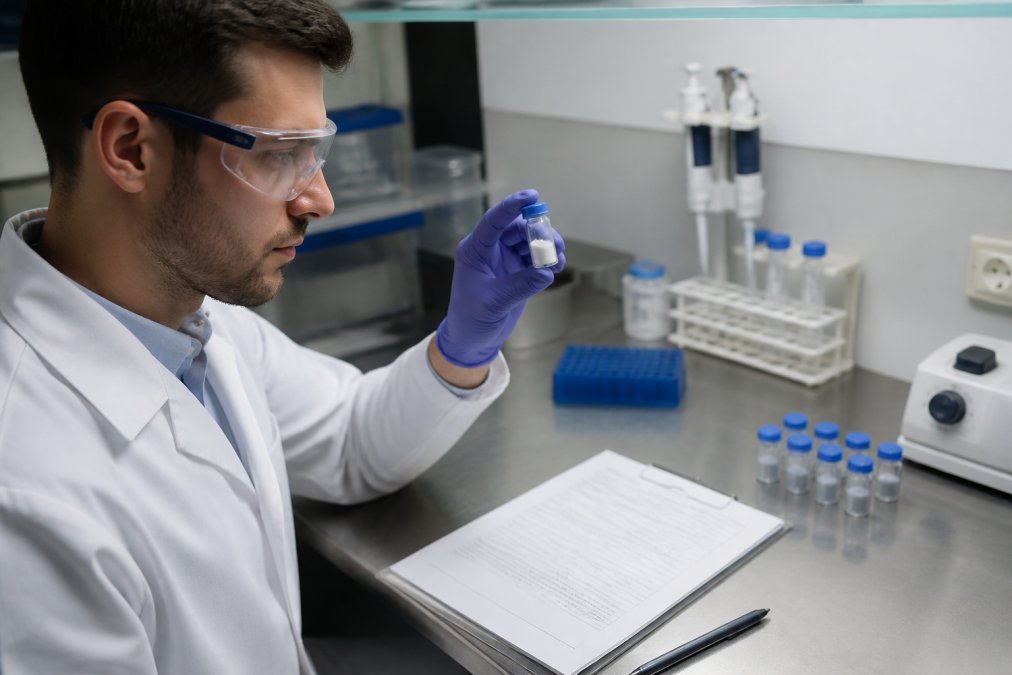
When evaluating where to buy peptides, look for Certificates of Analysis (COAs) from independent laboratories. A COA proves a third party with recognized accreditation tested your specific batch, creating accountability beyond internal quality control.
Reading and Interpreting Certificates of Analysis
A COA must identify the testing methodology, batch number, analysis date, and quantifiable purity results.
Credible COAs include HPLC (High-Performance Liquid Chromatography) and mass spectrometry data. HPLC quantifies the main compound versus impurities; mass spectrometry confirms molecular weight and structural integrity.
Verify the batch number matches your order, the testing date is recent (within 30 days of shipment), and purity aligns with supplier claims. Clarify any discrepancies before use.
Understanding HPLC and Mass Spectrometry Results
HPLC produces a chromatogram where the largest peak is your target peptide and smaller peaks represent impurities. Reliable suppliers show 95% or higher purity for research-grade materials.
Mass spectrometry confirms molecular weight matches the theoretical value, proving correct synthesis. Aligned HPLC and mass spectrometry results confirm authenticity and purity.
cGMP Manufacturing for Research Compounds
cGMP (current Good Manufacturing Practice) certification indicates FDA-regulated manufacturing standards: documented procedures, qualified personnel, controlled environments, and validated processes (the FDA). This is the baseline separating professional suppliers from informal operations.
cGMP facilities maintain batch records, perform in-process testing, and conduct stability studies. This traceability protects your research by identifying affected batches.
cGMP-certified manufacturers have been audited and verified to meet manufacturing standards. Minuteman Peptides sources from US-based cGMP-certified facilities.
ISO/IEC 17025 Peptide Testing: What It Means
ISO/IEC 17025 accreditation certifies a laboratory’s competence in performing specific tests (NIST Quality System | NIST). For peptides, it proves reliable HPLC, mass spectrometry, and other analytical methods with documented accuracy.
ISO/IEC 17025-accredited laboratories maintain calibration records, participate in proficiency testing, and undergo regular audits. Peer reviewers and regulatory bodies recognize this credential, and publications citing verified results face fewer peer review challenges.
ISO/IEC 17025 accreditation answers the critical question: how do you know the testing laboratory’s results are trustworthy? It’s recognized verification of international standards for competence and reliability.
Evaluating Supplier Reliability and Supply Chain Transparency
Reliable suppliers maintain consistent manufacturing and testing standards across multiple orders, document their processes, and respond promptly to questions.
Batch Testing and Consistency Across Orders
Expect COAs for each batch with purity consistent within 1-2 percentage points. Significant variations suggest inconsistent manufacturing or unreliable testing.
Ask if suppliers test every batch (reputable ones do) and maintain stability and shelf-life data. These details prove understanding of peptide stability science.
Evasive responses about processes suggest the supplier doesn’t fully understand or control their manufacturing.
Legal and Regulatory Considerations for Research Peptide Procurement
Verify the supplier’s labeling clearly states “for research use only” or “not for human consumption.”
Suppliers operating legally maintain documentation of cGMP certification and facility registration with regulatory bodies.
When evaluating where to buy peptides, confirm that the supplier operates transparently regarding regulatory compliance. Legitimate suppliers don’t hide their manufacturing location or testing procedures. They’re proud of their standards because those standards protect both the researcher and the supplier.
Storage, Handling, and Stability Requirements
Peptides are biochemical compounds that degrade under certain conditions. Temperature, humidity, light exposure, and time all affect stability. A responsible supplier provides clear storage instructions and stability data showing how long their peptides remain viable under specified conditions. However, proper storage begins the moment you receive your shipment, and most researchers lack a systematic approach to maintaining peptide integrity.
Temperature and Environmental Storage Standards
Most research-grade peptides require cold storage, typically at 2-8°C (refrigerator) or freezing at −20°C or below (freezer). Some lyophilized peptides are more stable at room temperature, but this should be explicitly documented. The supplier should specify whether reconstituted peptides have a limited shelf-life and provide guidance on storage after reconstitution.
The difference between storage temperatures matters significantly. Peptides stored at 2-8°C degrade faster than those stored at −20°C, which degrade faster than those stored at −80°C. If your research timeline extends beyond six months, −20°C or −80°C storage is strongly recommended. Room-temperature storage should only be used for peptides explicitly validated for stability at that temperature, typically only certain lyophilized, hydrophobic peptides with protective excipients.
Temperature fluctuations are as damaging as absolute temperature. A freezer that cycles between −15°C and −25°C causes more degradation than one maintained at a constant −20°C. Avoid storing peptides in a standard laboratory freezer where the door opens frequently. Dedicated −20°C or −80°C freezers with minimal temperature swing are ideal. If using a standard freezer, place peptides in an insulated box or the back of the freezer where temperature is most stable.
Humidity and Light Protection
Humidity accelerates peptide degradation, particularly for lyophilized peptides. Moisture promotes hydrolysis of peptide bonds and oxidation of sensitive amino acids (methionine, tryptophan, cysteine). Store peptides in a dry environment. If your laboratory has high ambient humidity, use desiccant-lined storage containers or store peptides in a desiccator cabinet.
Light exposure, especially UV light, degrades peptides containing aromatic amino acids. Store peptides in opaque or amber-colored vials, not clear glass. If your supplier provides peptides in clear vials, transfer them to amber vials for long-term storage. Keep peptides away from direct sunlight and intense laboratory lighting. A dark freezer or a light-protected storage box is ideal.
Reconstitution and Handling Protocols
Once you reconstitute a lyophilized peptide (dissolve it in solvent), its stability changes dramatically. Reconstituted peptides are typically stable for only days to weeks, depending on the solvent and storage temperature. The supplier should provide specific guidance on reconstitution solvents and post-reconstitution shelf-life.
When reconstituting peptides, use sterile, endotoxin-free water or the solvent recommended by the supplier. Avoid using tap water or non-sterile solvents, which introduce contaminants that accelerate degradation. Use sterile pipette tips and work in a clean environment to minimize bacterial contamination. Bacterial growth in a reconstituted peptide solution will degrade the peptide and compromise your research.
After reconstitution, store the solution at 2-8°C if you’ll use it within one week, or at −20°C for longer storage. Reconstituted peptides stored at room temperature degrade rapidly, typically within 24-48 hours. If you reconstitute a peptide and don’t use it immediately, freeze it in small aliquots to avoid repeated freeze-thaw cycles. Each freeze-thaw cycle causes some degradation; minimizing the number of cycles preserves your material.
Stability Data and Shelf-Life Interpretation
Reputable suppliers provide stability data showing how purity changes over time under recommended storage conditions. This data typically takes the form of a stability curve or table showing purity at time zero (immediately after manufacture), and at intervals such as 3 months, 6 months, 12 months, and 24 months of storage at specified temperatures.
When reviewing stability data, look for the supplier’s definition of “acceptable” purity.
Detecting Peptide Degradation
Before using a stored peptide, assess whether it has degraded. Visual inspection is the first step: lyophilized peptides should be a uniform color (white, off-white, or the color specified by the supplier). Discoloration, clumping, or visible moisture suggests degradation or contamination. Reconstituted peptides should be clear or slightly turbid (depending on the peptide). Cloudiness, precipitation, or visible particles indicate degradation or contamination.
Documentation and Inventory Management
Maintain a peptide inventory log that records the following for each batch: supplier name, batch number, date received, storage location, storage temperature, original purity (from COA), and date opened/reconstituted. This log helps you track which batches are oldest and should be used first (first-in, first-out principle). It also creates a record if you need to troubleshoot failed experiments, you can correlate results with the specific batch and storage history.
Common Mistakes When Sourcing Research Peptides
The most costly mistake is prioritizing price over verification. A peptide that costs 30% less but lacks independent testing documentation isn’t a bargain, it’s a liability. You’ll spend far more time repeating failed experiments than you’ll save on material costs.
Frequently Asked Questions
What makes a research peptide supplier legitimate and trustworthy?
A legitimate supplier provides transparent Certificates of Analysis verified by independent ISO/IEC 17025 certified laboratories, sources from cGMP-certified US-based manufacturing facilities, and publishes HPLC and Mass Spectrometry results for every batch. Reputable suppliers also maintain consistent quality across multiple orders, offer clear documentation of their supply chain, and respond promptly to questions about testing protocols and batch specifications. Verify certifications directly with the issuing laboratory rather than relying solely on vendor claims.
Why is ISO/IEC 17025 certification important when buying peptides?
ISO/IEC 17025 certification ensures the testing laboratory meets international standards for competence, impartiality, and consistent performance. This accreditation means the lab’s analytical methods, such as HPLC and Mass Spectrometry, have been independently validated and regularly audited. When a peptide supplier uses an ISO/IEC 17025 certified third-party laboratory, you receive purity and identity data that is scientifically defensible and suitable for peer-reviewed research. This certification reduces the risk of relying on biased or inadequately controlled testing performed by the supplier alone.
How do I interpret HPLC and Mass Spectrometry results on a Certificate of Analysis?
HPLC (High-Performance Liquid Chromatography) measures peptide purity by separating components and showing the percentage of the target compound versus impurities. Mass Spectrometry confirms molecular weight and structural identity. On a COA, look for HPLC purity percentages (typically ≥95% for high-quality research peptides), retention times that match the reference standard, and mass-to-charge ratios that correspond to your peptide’s expected molecular weight. Compare these values against your experimental requirements and any published standards for your specific peptide. Request clarification from the supplier if results appear inconsistent or if methodology details are missing.
What are the risks of purchasing peptides from non-cGMP facilities?
Non-cGMP facilities lack standardized manufacturing controls, documentation, and quality assurance protocols required by cGMP (Current Good Manufacturing Practice) standards. This increases the risk of batch-to-batch inconsistency, contamination, inadequate testing, and unreliable purity claims. For research requiring reproducible results across multiple experiments or publications, non-cGMP sourced peptides can compromise data integrity and waste research time and funding on failed experiments. Additionally, regulatory compliance becomes uncertain if your research involves pharmaceutical development or clinical translation pathways.


