

Table of Contents
- Why Peptide Purity Standards Decide Whether Your Data Holds Up
- How to Read COA Documents Without Getting Fooled
- HPLC Peptide Purity Analysis: What the Chromatogram Actually Tells You
- Mass Spectrometry Peptide Verification: Confirming Identity, Not Just Purity
- cGMP Manufacturing Standards for Peptides and What They Mean for Your Lab
- Comparing Purity Thresholds: 95% vs 99% and What You’re Actually Buying
- Standardization, Degradation, and the Two Angles Most Guides Skip
- Conclusion
- Frequently Asked Questions
Last Updated: September 26, 2026
Why Peptide Purity Standards Decide Whether Your Data Holds Up
Peptide purity standards for laboratories are the defined analytical benchmarks, typically expressed as a percentage of the target peptide relative to all detectable species in a sample, that determine whether a compound is fit for reproducible research. A certificate can read 98% and still hide a synthesis fragment that quietly skews a dose-response curve.
How to Read COA Documents Without Getting Fooled
A Certificate of Analysis is a batch-specific document stating the test methods, results, and specifications a compound was measured against. Reading it well means checking that the methods match the claim, not just that the final percentage looks acceptable. Most guides stop at “look for HPLC and LC-MS”, that is the entry fee, not the audit. The real work is reconciling what the document says against what the method can actually prove.
Start with these six checks, in order:
- Method named and specified: Does it name HPLC and LC-MS, or just say “tested”? A method without a column type, mobile phase, gradient, and detection wavelength is not reproducible.
- Detection wavelength stated: Purity by UV at 214 nm (peptide bond absorption) and purity by UV at 280 nm (aromatic residues) are not the same measurement. A COA that omits the wavelength is reporting a number you cannot compare to any other lab’s number.
- Integration parameters disclosed: Baseline selection, shoulder handling, and whether minor peaks below a threshold were excluded all change the final percentage. A trace that integrates only the main peak and ignores shoulders will read higher than an honest full-trace integration of the same vial.
- Batch linkage: Does the lot number on the COA match the vial in your hand? A COA is batch-specific by definition; a generic document is marketing, not analysis.
- Specification column: Is there a stated pass/fail threshold, or only a result? A result without a specification tells you what was measured, not whether it passed.
- Laboratory identity and accreditation: Is the testing lab named, and is it accredited to [ISO/IEC 17025(/why-independent-peptide-testing-matters-for-research/) | iso.org]? An anonymous lab result cannot be verified or challenged.
Red Flags in a Certificate of Analysis
The most common red flag is a purity figure with no chromatogram attached. A number without a trace is an assertion, not evidence. Other warning signs include:
- “Identity: confirmed” with no mass-to-charge value. Identity confirmation requires a reported m/z that matches the theoretical molecular weight of the sequence within the instrument’s tolerance. A verbal confirmation is not a measurement.
- No issue date or no revision history. Analytical documents are dated artifacts. An undated COA cannot be tied to a batch run.
- Template reuse across unrelated compounds. If the same layout, same method description, and same specification language appear across peptides of different lengths and sequences, the document was likely generated from a template rather than from batch-specific testing.
- Purity reported without counter-ion disclosure. If the COA states a purity percentage but never names the counter-ion (TFA, acetate, chloride) or its content, the number cannot be converted to actual peptide mass. This is the single most common technical omission in research-grade documentation.
- No method-to-result traceability. A legitimate report ties a specific result to a specific method on a specific date, run by a named laboratory. If any link in that chain is missing, the number is unverifiable.
Reconciling Conflicting COAs Across Labs
When two suppliers report different purity for what should be the same peptide, the discrepancy is usually methodological, not chemical. A common pattern is one lab reporting purity by UV peak area at 214 nm with full-trace integration, and another reporting by relative quantification against an external standard curve. Both numbers can be technically accurate and still not comparable.
Request the analytical method alongside the result. If a supplier reports chromatographic purity without naming the detection wavelength and integration method, you are comparing numbers that may not mean the same thing.
HPLC Peptide Purity Analysis: What the Chromatogram Actually Tells You
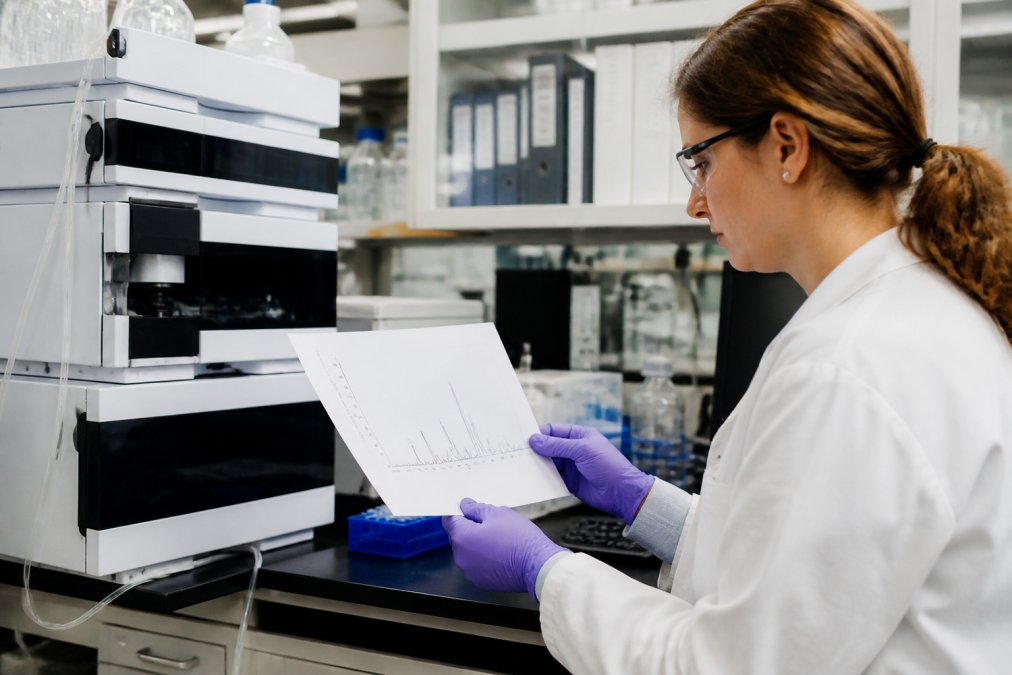
High-performance liquid chromatography separates the components of a sample by how they interact with a stationary phase, and the resulting trace is the primary evidence behind most purity claims. The main peak represents your target peptide; everything else is something you did not order.
Reading Retention Time and Peak Area
Retention time is the time a compound takes to travel through the column, and it functions as a fingerprint: if the target peak elutes at the expected time, the identity is plausible. Peak area is the basis of the purity calculation, expressed as the percentage of total integrated area. An honest report shows the full trace, including small shoulders and minor peaks, not a cropped image centered on the main peak.
Mass Spectrometry Peptide Verification: Confirming Identity, Not Just Purity
Mass spectrometry peptide verification confirms that the molecule in the vial is the molecule on the label, which is a separate question from how pure it is. LC-MS couples the separation step to a mass analyzer, producing a mass-to-charge ratio for each eluting species.
cGMP Manufacturing Standards for Peptides and What They Mean for Your Lab
cGMP manufacturing standards for peptides are the current Good Manufacturing Practice requirements that govern how a compound is produced, documented, and traced from raw material to finished vial. The relevant framework for most research compounds sits with the FDA’s current Good Manufacturing Practice regulations, which set expectations for facility controls, batch records, and deviation handling.
Impurity Profiles You Should Expect from SPPS
SPPS builds a peptide chain one residue at a time on a resin. Each coupling and deprotection step has a nonzero failure rate, and the resulting impurity profile is characteristic of the chemistry, not random contamination. The main classes are:
- Deletion sequences: A missed coupling leaves a peptide one residue short. These are often the closest-eluting impurities on HPLC and can co-elute with the target peak if the gradient is not optimized.
- Truncation products: Incomplete deprotection or premature chain termination produces shorter fragments. Their mass difference from the target is usually a clean multiple of an amino acid residue, which is why LC-MS is the right tool to detect them.
- Racemization: Base-mediated deprotection can convert L-amino acids to D-isomers. The mass is identical, so LC-MS will not flag it; only chiral chromatography or a dedicated racemization assay will.
- Oxidation: Methionine, cysteine, and tryptophan residues are oxidation-prone. Oxidized species show a +16 Da mass shift on LC-MS and often appear as a shoulder on the main HPLC peak.
- Counter-ion carryover: TFA from purification can remain bound to the peptide, contributing mass without contributing activity. This is why counter-ion disclosure belongs on the COA, not in a footnote.
Batch-Level Documentation to Demand
A facility certificate tells you the building passed an inspection. It does not tell you what happened in the vial you are holding. For each batch, request:
- Batch record summary: The synthesis and purification steps, including any deviations and how they were resolved.
- Impurity profile: The identified impurity classes and their relative percentages, not just the main-peak purity.
- Counter-ion identity and content: TFA, acetate, or chloride, with the measured residual level.
- Residual solvent and TFA limits: Relevant if your assay is sensitive to acid carryover.
- Stability and storage data: The conditions under which the batch was tested and the recommended storage conditions.
A facility-level cGMP certificate is not batch-level evidence. If a supplier cannot produce a batch record summary and an impurity profile for the specific lot you received, the cGMP claim does not transfer to your vial.
What cGMP Status Does and Does Not Guarantee
cGMP status is a proxy for process discipline, not a guarantee of fitness for your specific assay. A cGMP-produced peptide can still fail your dose-response curve if the impurity profile includes a species your assay is sensitive to, and a non-cGMP peptide can perform perfectly if the synthesis was clean and the characterization was honest. The practical takeaway is to treat cGMP as one input among several: pair it with batch-level documentation, an independent ISO/IEC 17025 accredited test result, and a COA that discloses method, wavelength, integration, and counter-ion.
Comparing Purity Thresholds: 95% vs 99% and What You’re Actually Buying
The gap between 95% and 99% purity is not a minor quality upgrade; it is a different impurity load, and for sensitive assays that difference can dominate your results. A 95% preparation carries roughly five times the non-target material of a 99% preparation.
| Purity Tier | Typical Use Case | Impurity Consideration |
|---|---|---|
| 90-95% | Screening, non-quantitative work | Higher fragment load may skew curves |
| 95-98% | General in-vitro research | Acceptable for many assays |
| 98-99% | Sensitive signaling studies | Lower interference risk |
| 99%+ | Reference standards, validation | Best repeatability across batches |
The Role of Counter-Ions in Purity Calculations
Counter-ions are the charged species that balance a peptide’s net charge, and they are frequently excluded from purity math. A peptide isolated as a trifluoroacetic acid salt carries TFA; one isolated as an acetate salt carries acetate. Because the counter-ion contributes mass but is not the peptide, two samples with identical chromatographic purity can deliver different amounts of active compound by weight.
If a COA reports purity by HPLC but never states the counter-ion or its content, you cannot accurately calculate how much peptide you are weighing out. This is a common source of failed replication between labs.
Standardization, Degradation, and the Two Angles Most Guides Skip
Reporting standards differ across laboratories, and that inconsistency is the quiet problem behind most “unexplained” replication failures. One lab reports purity by UV peak area at 214 nm; another reports by relative quantification against a standard curve. The percentages are not directly comparable, even when both are technically accurate.
Conclusion
Minuteman Peptides sources from cGMP-certified, US-based manufacturing facilities and routes every batch through independent ISO/IEC 17025 certified third-party testing, with HPLC and mass spectrometry results published in transparent Certificates of Analysis. If repeatability across batches is what your work depends on, get started with Minuteman Peptides and verify the data before you trust the number.
Frequently Asked Questions
What is the industry standard for research peptide purity?
Most research applications require 95% or higher purity as a baseline, with 98% or above preferred for sensitive assays. The right threshold depends on your experiment: cell culture work tolerates lower purity than receptor binding studies. Always match the purity specification to your assay sensitivity rather than assuming one number fits every protocol.
How do I interpret a Certificate of Analysis for peptides?
Start with the testing laboratory’s accreditation. Look for ISO/IEC 17025 certification, which confirms the lab meets international competence standards. Then verify the HPLC chromatogram shows a single dominant peak, check the mass spectrometry result against the theoretical molecular weight, and confirm the batch number matches your vial. A COA without raw data or accreditation details is a red flag.
Why is HPLC and Mass Spectrometry testing critical for research peptides?
HPLC separates and quantifies peptide components, revealing purity percentage and synthesis fragments. Mass spectrometry confirms molecular identity by measuring mass-to-charge ratio against the expected peptide sequence. Together they catch two different problems: how much impurity exists and whether the compound is actually what the label claims. One test alone leaves a blind spot.
What are the FDA impurity thresholds for synthetic peptides?
The FDA does not publish a single universal impurity threshold for research peptides. For pharmaceutical applications, ICH guidelines govern allowable impurities, but research-grade peptides fall outside that framework. This is why third-party analytical validation matters: without a regulatory floor, your COA and the testing lab’s standards become your quality benchmark.
How does ISO/IEC 17025 certification impact peptide quality?
ISO/IEC 17025 certifies that a testing laboratory operates with validated methods, calibrated equipment, and documented standard operating procedures. It does not guarantee the peptide itself is pure, but it means the numbers on the COA were generated under controlled, auditable conditions. An unaccredited lab can report 99% purity with no accountability behind the figure.
What is the difference between crude and high-purity peptides?
Crude peptides come directly from solid-phase peptide synthesis with impurities, truncated sequences, and residual solvents intact. Purity typically ranges from 60% to 80%. High-purity peptides undergo HPLC purification and lyophilization to remove synthesis fragments and counter-ions, reaching 95% or higher. For metabolic pathway research, crude material introduces variables that can skew results.
Why do two labs report different purity percentages for the same peptide batch?
Different labs use different HPLC columns, mobile phases, detection wavelengths, and integration methods. Counter-ion content also affects calculations: a peptide reported as 98% by one lab may read 95% at another if trifluoroacetic acid or acetate content is counted differently. Always compare COAs from the same testing laboratory when tracking batch consistency over time.


