

Table of Contents
- What Makes Research Peptides Suitable for Neuroscience Studies
- Key Peptide Compounds Studied in Neuroscience Research
- Understanding Peptide Certificate of Analysis for Research Quality
- HPLC and Mass Spectrometry Peptide Testing: What the Data Means
- Selecting a Research Peptide Supplier: Standards That Matter
- Batch Consistency and Reproducibility in Peptide Research
- Frequently Asked Questions
Last Updated: October 9, 2026
What Makes Research Peptides Suitable for Neuroscience Studies
High purity research peptides for neuroscience studies 2026 are a critical foundation for advancing our understanding of brain function. Even trace contaminants can skew results, compromise reproducibility, and waste months of laboratory time chasing false signals.
At Minuteman Peptides, we recognize that the difference between a successful study and a failed one often hinges on compound quality. Research-grade peptides must be synthesized with precision, tested rigorously, and documented transparently so your findings stand up to peer review.
Three core factors separate suitable peptides from unsuitable ones: the synthesis method must preserve structural integrity, the testing protocol must verify purity at the molecular level using validated techniques, and the documentation must let another lab replicate your work.
Most researchers discover too late that “research-grade” claims vary wildly across suppliers. One vendor’s 98% purity might mean something entirely different from another’s, so understanding how to verify those claims matters before you commit your project timeline and budget.
Key Peptide Compounds Studied in Neuroscience Research
Neuroscience researchers investigate a focused set of peptide compounds that have shown measurable activity in cellular and molecular studies. Understanding what each compound is studied for helps you select the right material for your research question.
Semax and Cognitive Function Research
Semax is a synthetic peptide fragment derived from adrenocorticotropic hormone (ACTH). In neuroscience studies, it has been investigated for potential effects on cognitive processes and neuronal signaling pathways, particularly neural plasticity and memory-related mechanisms at the cellular level.
Researchers studying Semax focus on its interactions with neuropeptide systems and its potential role in neuronal communication, often using in vitro models. When sourcing Semax, high purity is essential because even minor impurities can affect how the compound interacts with cellular receptors and signaling pathways.
Selank and Neurological Signaling
Selank is a synthetic peptide constructed as a tuftsin analogue, designed to investigate neurological signaling mechanisms. In neuroscience research, it has been studied for potential effects on neural communication and brain cell function, particularly how it may modulate neurotransmitter systems.
Studies examining Selank typically employ in vitro models to assess its effects on neuronal signaling and cellular responses. High-purity Selank ensures that observed effects reflect the compound’s true biological activity, not contamination artifacts.
Dihexa and Neuroplasticity Studies
Dihexa is a research compound investigated for its potential effects on neuroplasticity and brain cell development. In neuroscience research, it has been examined for how peptides might support neural connection formation and synaptic plasticity, focusing on neuronal adaptation and cellular repair pathways.
Researchers using Dihexa typically measure changes in neuronal morphology, connectivity, or gene expression related to plasticity. Purity verification is critical because the compound’s effects are studied at concentrations where trace impurities could introduce confounding variables.
BPC-157 and Brain Cell Research
BPC-157, or body protection compound-157, is a synthetic peptide investigated in neuroscience research for potential effects on brain cell function and neuroprotection. Its research applications include neuronal signaling, cellular repair mechanisms, and how the peptide might influence growth factors and cellular survival pathways.
In neuroscience studies, BPC-157 is examined using in vitro models to assess its effects on neural cells and their responses to stimuli. High-purity BPC-157 is essential because the compound’s mechanisms are still being elucidated, and contaminants could obscure the actual biological activity you’re trying to measure.
MOTS-c and Cellular Signaling Pathways
MOTS-c is a mitochondrial-derived peptide investigated in neuroscience research for potential effects on cellular signaling and metabolic pathways. Research typically focuses on how this peptide might support cellular energy metabolism and signaling cascades relevant to neurological health.
Researchers examining MOTS-c often explore its effects on mitochondrial function and cellular responses in neural tissue models, including potential mechanisms of cellular protection and metabolic support. Verifying high purity ensures your results reflect the peptide’s true biochemical activity rather than effects from contaminants or byproducts.
Understanding Peptide Certificate of Analysis for Research Quality
A peptide certificate of analysis (COA) is your primary tool for verifying that the compound you’ve received matches what you ordered. It documents analytical testing performed on a specific batch and serves as proof that quality standards were met.
The most credible COAs come from independent, third-party laboratories rather than the manufacturer alone. Look for evidence that testing was conducted by a facility certified under ISO/IEC 17025, the international standard for laboratory competence, meaning the lab has undergone rigorous assessment of its testing methods, equipment calibration, and quality control procedures.
A complete COA should include the peptide’s molecular weight, purity percentage, testing methods, date of analysis, and batch number. The batch number is crucial because it ties test results to your specific shipment and ensures traceability if you need to troubleshoot results or request a replacement batch.
Many researchers accept a COA without examining it critically. A high purity percentage is necessary but not sufficient; you need to know what analytical method determined that purity. HPLC and mass spectrometry are the gold standards, but other methods may not provide the same level of confidence.
| Component | What It Tells You | Why It Matters |
|---|---|---|
| Purity % | Percentage of target compound vs. impurities | Determines if the peptide is suitable for your research |
| Molecular Weight | Actual mass of the compound | Confirms correct peptide synthesis and structure |
| Testing Method | HPLC, MS, or other analytical technique | Indicates reliability and precision of results |
| Batch Number | Unique identifier for this specific shipment | Enables traceability and batch-specific comparisons |
| Test Date | When analysis was performed | Ensures results reflect your actual material |
HPLC and Mass Spectrometry Peptide Testing: What the Data Means
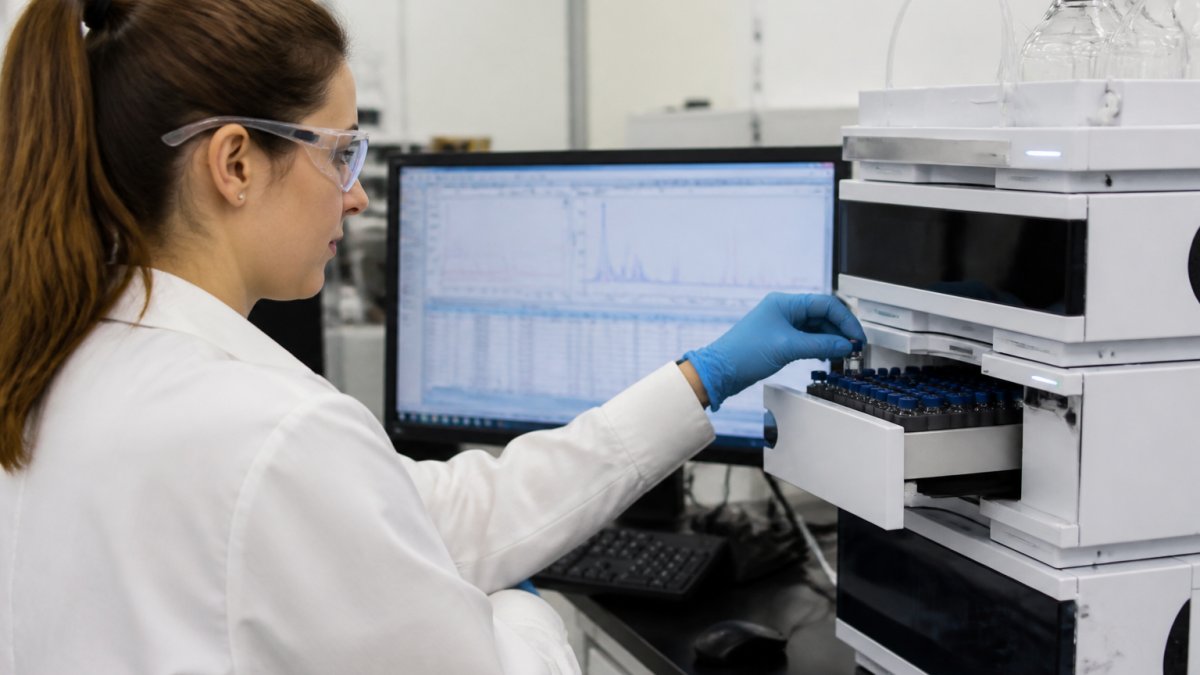
High-performance liquid chromatography (HPLC) and mass spectrometry (MS) are the analytical methods that define research-grade peptide testing, separating, identifying, and quantifying peptide molecules with high precision.
HPLC forces a liquid sample through a column packed with tiny particles. Different compounds travel at different speeds based on their chemical properties, and a detector measures how much compound passes through at each time point.
Mass spectrometry measures the actual mass of molecules. A peptide entering a mass spectrometer is ionized and broken into fragments, and the instrument measures their mass-to-charge ratio, creating a unique fingerprint.
When you read HPLC data on a COA, look for a purity value stated as a percentage; 95% or higher is typical for research-grade peptides. But that percentage only applies to what HPLC can detect.
Mass spectrometry data complements HPLC by confirming molecular identity. A strong peak at the expected molecular weight with minimal peaks elsewhere is strong evidence that your peptide is both pure and correctly synthesized. When both HPLC and MS data are provided together, the purity claim is more reliable.
The practical implication: demand both HPLC and MS data from your supplier, not just one or the other. At Minuteman Peptides, we provide verified HPLC and Mass Spectrometry results for every batch because researchers need complete analytical documentation to justify their experimental design and defend their results.
Selecting a Research Peptide Supplier: Standards That Matter
Choosing a peptide supplier requires evaluating multiple dimensions beyond price. Several standards distinguish suppliers committed to research integrity from those cutting corners.
Manufacturing standards matter first. Look for suppliers whose facilities are cGMP-aligned, meaning they follow Current Good Manufacturing Practice guidelines for pharmaceutical production (the FDA). A cGMP-aligned facility doesn’t guarantee perfection, but it means systematic quality control is built into every step.
Independent third-party testing is non-negotiable. When a supplier tests its own products, there’s an inherent conflict of interest. Independent laboratories certified under ISO/IEC 17025 have no financial stake in the results and are subject to regular audits, assuring you that testing methods are validated and results are trustworthy.
Transparency in documentation separates reliable suppliers from those with something to hide. Request the full COA before purchase, not after, and ask for supporting documentation, test protocols, equipment specifications, and traceability records. Suppliers confident in their quality welcome these requests; those that resist are signaling risk.
Batch consistency over time is another critical factor. Ask the supplier for COAs from multiple batches of the same peptide produced over the past year. Do the purity percentages, molecular weights, and impurity profiles remain consistent? Significant variation between batches suggests manufacturing or quality control problems. Consistency indicates reliable processes.
Communication and responsiveness matter when problems arise. Before committing to a supplier, test their responsiveness. Ask technical questions about their testing methods or manufacturing processes. Do they answer promptly and thoroughly, or do they give vague responses? A supplier that engages seriously with your questions is more likely to support you if an issue emerges mid-project.
Batch Consistency and Reproducibility in Peptide Research
Reproducibility is the foundation of scientific credibility. When your research uses peptides from different batches or different suppliers, batch-to-batch variation can introduce variables that confound your results.
Batch consistency begins with manufacturing control. Peptides are synthesized through a series of chemical reactions. If reaction conditions vary, temperature, timing, reagent purity, the final product will vary. Suppliers using automated synthesis with tight process controls produce more consistent batches than those relying on manual procedures with wider tolerances.
The analytical data on each COA tells you whether consistency was achieved. When you compare COAs from successive batches of the same peptide, look for:
- Purity percentages within a tight range (e.g., 97.2% to 98.1%, not 96% to 99%)
- Molecular weight values matching to the decimal place
- Consistent impurity profiles showing the same minor peaks in similar proportions
- Test dates spaced appropriately (suggesting regular production, not stockpiling)
Significant variation in any of these metrics indicates inconsistent manufacturing or quality control. Over an 18-month research project requiring multiple batches, consistency becomes your insurance policy against false results.
Reproducibility also depends on your ability to obtain replacement batches if needed. Ask potential suppliers about their batch retention policy. Do they keep samples from each batch for a defined period? Can they re-test a batch months later if you identify a problem?
At Minuteman Peptides, we understand that your research depends on material you can rely on across multiple batches and months. Our cGMP-certified US-based manufacturing and independent ISO/IEC 17025 certified third-party testing create the consistency that reproducible research demands.
Selecting high purity research peptides for neuroscience studies 2026 requires more than finding the lowest price. Your research integrity depends on material that meets documented standards, has been tested by independent laboratories, and demonstrates batch-to-batch consistency. Our verified HPLC and Mass Spectrometry results give you the purity and reproducibility your research demands.
Frequently Asked Questions
How do I verify the purity of a research peptide before using it in my study?
Verify purity by requesting and carefully reviewing the peptide certificate of analysis from your research peptide supplier. Look for HPLC and mass spectrometry peptide testing results that confirm the compound’s identity and purity percentage. Confirm that the testing was performed by an ISO/IEC 17025 certified third-party laboratory, not just the manufacturer. Cross-reference the batch number on the COA with the label on your received product. Request documentation of the analytical methods used and the detection limits to ensure they are appropriate for your research application.
What should I look for in a research peptide supplier’s credentials?
A reliable research peptide supplier should provide cGMP-certified manufacturing documentation, independent third-party testing from ISO/IEC 17025 accredited laboratories, and transparent certificates of analysis for every batch. Verify that testing includes both HPLC and mass spectrometry peptide testing results. Ask about batch-to-batch consistency records. Confirm the supplier’s ability to provide documentation suitable for regulatory compliance if your research requires it.
Why is batch-to-batch consistency important for neuroscience research?
Batch-to-batch consistency ensures that your experimental results remain reproducible over time. Neuroscience studies often require multiple rounds of testing across months or years, and variations in peptide purity or composition between batches can introduce confounding variables that compromise your findings. Inconsistent batches may produce conflicting results, making it difficult to publish or validate your research. A research peptide supplier that maintains detailed purity testing records and quality standards helps you maintain experimental integrity and confidence in your data across the entire duration of your study.
What is the difference between HPLC and mass spectrometry peptide testing?
HPLC (High-Performance Liquid Chromatography) separates peptide compounds by their chemical properties and measures purity percentage by detecting the proportion of your target compound versus impurities. Mass spectrometry identifies the exact molecular weight and structure of the peptide, confirming that the compound is what it claims to be. Together, these methods provide both identity verification and purity quantification. HPLC shows you how pure the sample is; mass spectrometry confirms you have the correct compound. Both tests should appear on your peptide certificate of analysis from a qualified research peptide supplier.


