

Table of Contents
- Why Independent Peptide Batch Testing Matters for Research Integrity
- How HPLC Peptide Analysis Verifies Purity and Identity
- Mass Spectrometry Peptide Testing: Confirming Structural Integrity
- How to Read a Peptide COA: A Practical Checklist
- Independent Testing vs. Supplier-Provided Testing: What’s the Difference?
- What Independent Testing Can and Cannot Establish
- Batch Consistency and Reproducibility Across Multiple Orders
- Frequently Asked Questions
Last Updated: October 10, 2026
Why Independent Peptide Batch Testing Matters for Research Integrity
Independent peptide batch testing is the foundation of reproducible research. When you work with compounds that lack verified purity and identity data, your experimental results become unreliable. You can’t distinguish between real biological effects and artifacts introduced by contamination or degradation.
This is where independent peptide batch testing changes everything. Third-party verification removes the conflict of interest inherent in supplier-provided testing. The laboratory performing the analysis has no financial stake in reporting high purity, they’re paid to deliver accurate data, not favorable numbers.
At Minuteman Peptides, we understand that research integrity depends on transparency. Every batch we supply undergoes rigorous testing by U.S-based ISO/IEC 17025 certified independent laboratories. This certification means the testing facility meets strict international standards for competence, impartiality, and technical capability. Your research deserves compounds with verified specifications, not marketing claims.
Request the independent laboratory’s accreditation credentials before trusting their results. ISO/IEC 17025 certification is the standard that matters, it verifies the lab meets international quality standards for analytical testing.
How HPLC Peptide Analysis Verifies Purity and Identity
HPLC (High-Performance Liquid Chromatography) is the analytical method that separates peptide compounds into individual components based on their chemical properties (Checking your browser). As each component exits the instrument, a detector measures its presence and quantity.
HPLC peptide analysis works by injecting your sample into a column packed with specialized material. Different peptides interact with this material differently, so they travel through at different speeds. The instrument records when each component emerges, creating a unique fingerprint.
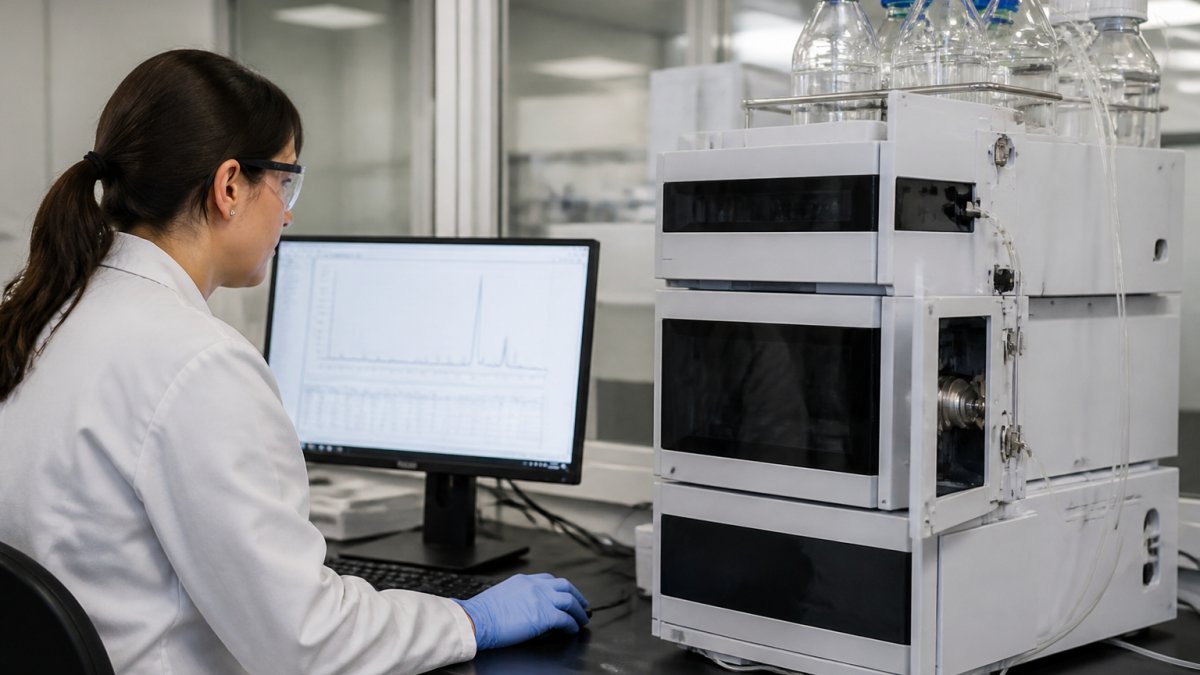
What makes HPLC peptide analysis valuable for independent testing is its objectivity. The instrument doesn’t care about profit margins or customer satisfaction, it measures what’s actually in the sample. When an independent laboratory reports HPLC results, you’re seeing the raw instrumental data, not an interpretation designed to satisfy the supplier.
The purity percentage reported on your certificate of analysis comes directly from HPLC integration. The software calculates what fraction of the total signal comes from your target peptide versus everything else. A 98% purity claim means 98% of the measured signal corresponds to your intended compound.
HPLC peptide analysis gives you a chemical fingerprint of your sample. Independent testing ensures that fingerprint reflects reality, not supplier preferences.
Mass Spectrometry Peptide Testing: Confirming Structural Integrity
Mass spectrometry peptide testing answers a question HPLC alone cannot: is the peak you’re seeing actually your peptide, or something with similar chromatographic behavior? Mass spectrometry measures the exact molecular weight of compounds, providing definitive structural confirmation.
When a peptide enters a mass spectrometer, the instrument ionizes it and measures its mass-to-charge ratio (Mass Spectrometry for Proteomics). This produces a precise molecular weight. Since peptide sequences are highly specific, the molecular weight is essentially a fingerprint of the amino acid sequence.
This is critical for independent peptide batch testing. A supplier could theoretically deliver a high-purity impurity, a substance that looks pure on HPLC but isn’t your target peptide. Mass spectrometry catches this immediately. The molecular weight will be wrong, revealing the substitution.
Structural fingerprinting through mass spectrometry also detects oxidation, incomplete synthesis, or unexpected modifications. These changes alter molecular weight, creating peaks at different mass values. An independent laboratory performing mass spectrometry peptide testing documents these variations in detail, giving you complete visibility into what you actually received.
The combination of HPLC and mass spectrometry peptide testing creates a verification system. HPLC confirms purity, that your sample contains primarily one substance. Mass spectrometry confirms identity, that substance is actually your target peptide. Together, they eliminate ambiguity about what you’re working with.
How to Read a Peptide COA: A Practical Checklist
A Certificate of Analysis (COA) is your evidence that independent peptide batch testing actually happened. But many researchers don’t know what to look for when reading one.
Start by verifying the independent laboratory’s credentials. Look for ISO/IEC 17025 accreditation statement, this should appear on the COA or be verifiable through the lab’s website.
Next, check that the COA includes batch-specific information. If the COA is from six months before you receive the product, the current purity may be lower than reported. Batch consistency requires batch-specific data, not generic claims about the product line.
Look for specific analytical methods listed: HPLC, mass spectrometry, or both. The methods section should name the specific technique and sometimes provide method details. If it just says “tested for purity” without naming the method, you don’t know what actually happened.
Practical COA Verification Checklist:
- Independent laboratory name and ISO/IEC 17025 accreditation number
- Your batch number and the testing date
- Specific analytical methods (HPLC, mass spectrometry, or both)
- Purity percentage with numerical value (e.g., 97.3%, not “high purity”)
- Molecular weight confirmation or mass spectrometry data
- Impurity profile showing what the remaining percentage consists of
- Storage conditions and stability data if provided
- Laboratory contact information for questions or disputes
- Digital signature or authentication method to verify COA hasn’t been altered
Examine the purity number closely. Legitimate COAs report specific percentages: 97.3%, 98.1%, 99.5%. If it says “greater than 95%” or “approximately 98%”, the laboratory is hedging. Precise numbers indicate actual measurement; vague ranges suggest estimation or rounding.
The impurity profile is equally important. A COA that lists only “purity: 98%” without explaining what the other 2% is tells you nothing. A detailed impurity profile breaks down residual solvents, synthesis byproducts, and degradation products.
A COA without a specific laboratory name, accreditation number, or testing date is essentially worthless. It’s marketing material, not verification. Always request a new COA directly from the independent laboratory if you have doubts about authenticity.
Independent Testing vs. Supplier-Provided Testing: What’s the Difference?
Supplier-provided testing creates a fundamental conflict of interest. The same company selling you the peptide is also certifying its quality. If the batch is slightly off-spec, the supplier faces a choice: report it honestly and lose a customer, or report it favorably and keep the sale.
Independent peptide batch testing removes this conflict. The testing laboratory has no relationship with the supplier and no financial interest in reporting high purity. They’re paid a fixed fee for analysis, regardless of the results. This separation creates the conditions for honest reporting.
The difference shows up in COA detail and defensibility. Supplier-provided COAs often lack specifics: they report purity ranges rather than exact percentages, skip impurity profiles, or don’t name the analytical methods used. These omissions aren’t accidental, they provide cover for inconsistent results.
Independent laboratories, especially those with ISO/IEC 17025 accreditation, operate under external audit. Their COAs must meet specific standards for documentation and detail. They maintain records that can be audited by accreditation bodies. This creates accountability that supplier-provided testing lacks.
For researchers doing reproducible work, this distinction matters enormously. If your experiment fails and you need to understand why, an independent laboratory’s detailed COA gives you diagnostic information. A supplier’s vague certificate tells you nothing.
What Independent Testing Can and Cannot Establish
Independent peptide batch testing has real power, but also real limitations. Understanding both prevents false confidence in your compounds.
Independent testing CAN establish:
- Identity confirmation through mass spectrometry, which measures molecular weight precisely enough to distinguish your target peptide from similar compounds
- Purity percentage through HPLC, showing what fraction of your sample is the target compound versus impurities
- Impurity profile identifying what the non-target fraction actually consists of, residual solvents, synthesis byproducts, degradation products, or contaminants
- Batch consistency when multiple batches are tested using identical methods, showing whether the supplier maintains reproducible quality
- Concentration verification if the COA includes quantitative analysis confirming the stated amount per unit
Independent testing CANNOT establish:
- Long-term stability from a single testing point. A COA shows purity at the moment of testing, not how the peptide will degrade over months of storage. Stability studies require multiple time-point testing, which most suppliers don’t provide.
- Biological activity or potency in living systems. HPLC and mass spectrometry confirm chemical structure, not whether the peptide actually works as intended in your experimental model.
- Sterility or endotoxin levels unless the COA explicitly includes these tests. Standard HPLC and mass spectrometry don’t detect bacterial contamination or pyrogens.
- Absence of undeclared contaminants beyond the detection limits of the methods used. If a method can’t detect a substance, a negative result doesn’t prove the substance isn’t there.
- Chain-of-custody integrity before the laboratory received the sample. If the peptide was stored improperly or exposed to heat before testing, the COA won’t reveal this. It only documents what the laboratory received.
This matters for research planning. If your experiments require sterile, endotoxin-free compounds, you need COAs that include sterility and endotoxin testing, not just HPLC purity data. If your work requires long-term stability assurance, you need stability data across multiple time points, not a single snapshot.
When you read an independent peptide batch testing report, ask yourself: does this test actually verify what I need verified? A perfect HPLC result doesn’t guarantee your compound will work in your assay if biological activity wasn’t measured. A single COA doesn’t guarantee the next batch will be consistent if batch verification testing wasn’t performed.
Batch Consistency and Reproducibility Across Multiple Orders
Reproducible research depends on reproducible inputs. If peptide batch A works perfectly but batch B fails, you can’t trust your results. This is why batch consistency matters as much as individual batch purity.
Independent peptide batch testing enables batch consistency verification by providing comparable data across multiple orders. When each batch undergoes identical testing by the same independent laboratory, you can directly compare results.
This level of transparency is rare. Many suppliers test batches inconsistently, sometimes using in-house methods, sometimes outsourcing, sometimes skipping testing entirely.
Minuteman Peptides maintains batch consistency through systematic independent peptide batch testing. Every batch goes to the same ISO/IEC 17025 certified independent laboratory using identical analytical methods.
For researchers running multi-month or multi-year studies, batch consistency data becomes essential documentation. If you publish results using peptides from five different batches, reviewers want evidence that all batches met the same specifications.
Batch verification also catches supplier problems early. If a new batch shows significantly different purity or impurity profile than previous batches, something changed in the manufacturing process.
Research integrity depends on transparent, verifiable compound specifications. When your experiments matter, your compounds should too. Shop Minuteman Peptides and get the verified purity your research deserves.
| Testing Type | What It Verifies | What It Cannot Verify | Best For |
|---|---|---|---|
| HPLC Peptide Analysis | Purity percentage, impurity profile, batch consistency | Biological activity, sterility, long-term stability | Identity and purity confirmation |
| Mass Spectrometry Peptide Testing | Molecular weight, structural identity, unexpected modifications | Concentration accuracy, biological function | Confirming target peptide structure |
| Independent Laboratory Testing | Objective third-party verification, audit trail | Supplier handling before testing, real-world performance | Reproducible research documentation |
| Supplier-Provided Testing | Cost reduction, faster turnaround | Conflict-of-interest mitigation, audit accountability | Budget-limited projects only |
Frequently Asked Questions
What does independent peptide batch testing actually verify?
Independent peptide batch testing confirms peptide identity, purity percentage, concentration, and the presence of impurities or contaminants. Third-party laboratories use analytical methods such as HPLC and mass spectrometry to generate objective data about what is actually in each batch. This verification ensures your research inputs meet specifications before experiments begin, protecting experimental validity and preventing time wasted on compromised materials.
How do I know if a certificate of analysis is legitimate?
Verify that the laboratory holding the ISO/IEC 17025 certification is independently accredited, check the accreditation body’s registry. A legitimate COA includes batch-specific data, analytical methods used, date of testing, and the laboratory’s accreditation number. Be cautious of COAs that lack method details, use vague language, or show no accreditation reference. Request documentation of the laboratory’s current accreditation status directly from the testing facility, not the supplier.
What is the difference between HPLC and mass spectrometry peptide testing?
HPLC measures purity by separating peptide components and quantifying the main compound’s percentage. Mass spectrometry confirms structural identity by measuring the exact molecular weight and fragmentation pattern. Together, they provide complementary data: HPLC tells you how pure the sample is, while mass spectrometry confirms you have the correct peptide. Using both methods reduces the risk of receiving a different compound that happens to be pure.
Can a high purity result guarantee my research will work?
No. A high purity percentage confirms the batch is chemically pure and correctly identified, but it does not guarantee suitability for your specific research application. Purity alone does not address stability under your storage conditions, potential batch-to-batch variability in activity, or whether impurities present at low levels affect your particular assay. Independent testing establishes material quality; your own validation in your experimental system is still required.


